
Legal
An Unconscionable Plan to Entrap and Falsely Imprison

On June 20th 2022, I decided to do a first amendment audit of Oxford Mississippi City Hall with a goal of requesting public records from the city clerk at the conclusion. These audits were something I had started doing as a citizen journalist to promote government transparency and accountability, and I had done several during the month of June. As I’m doing my audit documenting the inside of City hall, I am approached by Oxford police lieutenant Kevin Parker and ordered out of the building under detainment due to Parker stating mayor Robyn Tannehill had a restraining order for 2017 which was still allegedly active against me. Another supervisor, Captain Lyons, then approaches me, and I voice my disagreeance with all of this calling it unconstitutional to bar a citizen and journalist from City Hall based upon a five year old extremely shady restraining order taken out never renewed by a mayor whom I never asked for, and never saw while I was in City hall. Lyons says if I come back to City Hall I would be arrested for trespassing and violation of restraining order. I complied and I left.
On June 28th 2022 as I was walking into Lafayette county chancery Court for a child custody hearing I’m wandered by Major Alan Wilburn of the sheriff’s department and told I can’t come in with the recording devices per the judge. he then pulls out an arrest warrant for the charge of aggravated stocking which stem directly from me walking in the city hall on June 24th to do a first amendment audit. What I would later find out was that the Oxford police chief Jeff McCutchen had referred the matter which should have been squashed over to the Mississippi bureau of investigations and returned they felony charge of aggravated stocking citing the audit and five to six Twitter tweets against Tannehills policies one year prior during her reelection campaign as the course of conduct supposedly directed at Tannehill. I was given a $10,000 Bond set my Judge Kent Smith which was promptly moved to be revoked by assistant district attorney Tiffany kilpatrick. at the preliminary and revocation of bond hearing which gave the impression of the kangaroo court, judge Smith ruled that I be held without bond in order to mental health exam and competency hearing. my initially assigned public defender Mitchell Driskill was mysteriously replaced with another attorney by the name of Mark McClinton and was from New albany. However there was never any Court filing or entry authorizing the swap. what if what I quickly found out was that McClinton did not have my best interest at heart whatsoever. Not only could I rarely reach him, but the court ordered mental health exam wasn’t scheduled by him until nearly two months later, in September. Dr Christopher Lott conducted the mental health exam and concluded that I had no bipolar or any other major or noticeable mental health illness. The day before the competency hearing September 29th, I speak with McClinton on the phone he informs me the whole case fell apart from the state, they never had anything on me to begin with as the charge didn’t fit, and the following day the charge would be tossed completely at the competency hearing on September 30th. This never happened just following day McClinton springs a guilty plea on me telling me if I don’t take it, the jury would be tainted and fixed and the elements of the charge would be exploited likely sending me to prison, even if it moved to another adjacent county. He said if I accepted it, I’d go home in my family today, and get five years probation, banishment from Lafayette county for five years beginning 45 days later, and that he would expunge the charge when eligible. Due to a crisis with my family I felt my hands were tied and I took the Guilty plea, solely to get out take care of my family. I immediately told the McClinton this was a mistake and I wanted to withdraw my plea and go to trial. He wouldn’t entertainment he wouldn’t entertain it or assist with it so on October 31st 2022 I filed my own motion to withdraw guilty plea and either go to trial or dismiss the unconstitutional charge.
A few days prior, I witnessed an act of police corruption in a neighboring City and captured it on video. I reported this to the local FBI field office in Oxford Mississippi on October 28th 2022. I was advised to bring the video up to the field office a short time later and I recorded this call. I then called to Lafayette county sheriff’s office to report my requested presents at the FBI office in Oxford so as to being compliance with the circuit court order regarding the banishment.
On November 1st 2022, the day after I filed my motion to withdraw my guilty plea, the assistant district attorney filed a motion to revoke my sentence and hold me without bond for a revocation hearing, which is then ordered by judge Tollison.
I was arrested the evening of November 1st 2022 and held in jail until November 3rd for the revocation hearing. I was deprived fully of due process. I was never informed what I was being revoked for until I was brought to the hearing. No attorney was present for me and the fact that I went into the hearing blind not knowing what the revocation hearing was for meant that I was not afforded the opportunity to gather evidence or produce witnesses to prove my innocence. Some of the most crucial requirements to due process.
The testimony given by Sheriff’s Deputy Kandis Beavers was that I drove to the FBI office in Oxford Mississippi without having an appointment set, however this is untrue as a call recording shows, I did exactly as I was advised to do by an agent or employee of the FBI to bring evidence to their office of police corruption caught on video in another city.
Sheriff East allegedly called the FBI field office a short time later and some individual, or possibly the same one, told East that I didn’t have an appointment. I told the judge I had called recordings corroborating everything showing I did exactly as I was advised by the FBI to do, even me calling the sheriff’s department to report my needed presence.
However judge Tollison would not let me produce it, and after a short deliberation he sent me to serve one year in prison for violating the banishment, even though my reason for going to the FBI was lawful, for official reasons in order to enforce the equal protections of the law!
Can you say entrapment and false imprisonment among many others?
Discover more from We The People News
Subscribe to get the latest posts sent to your email.


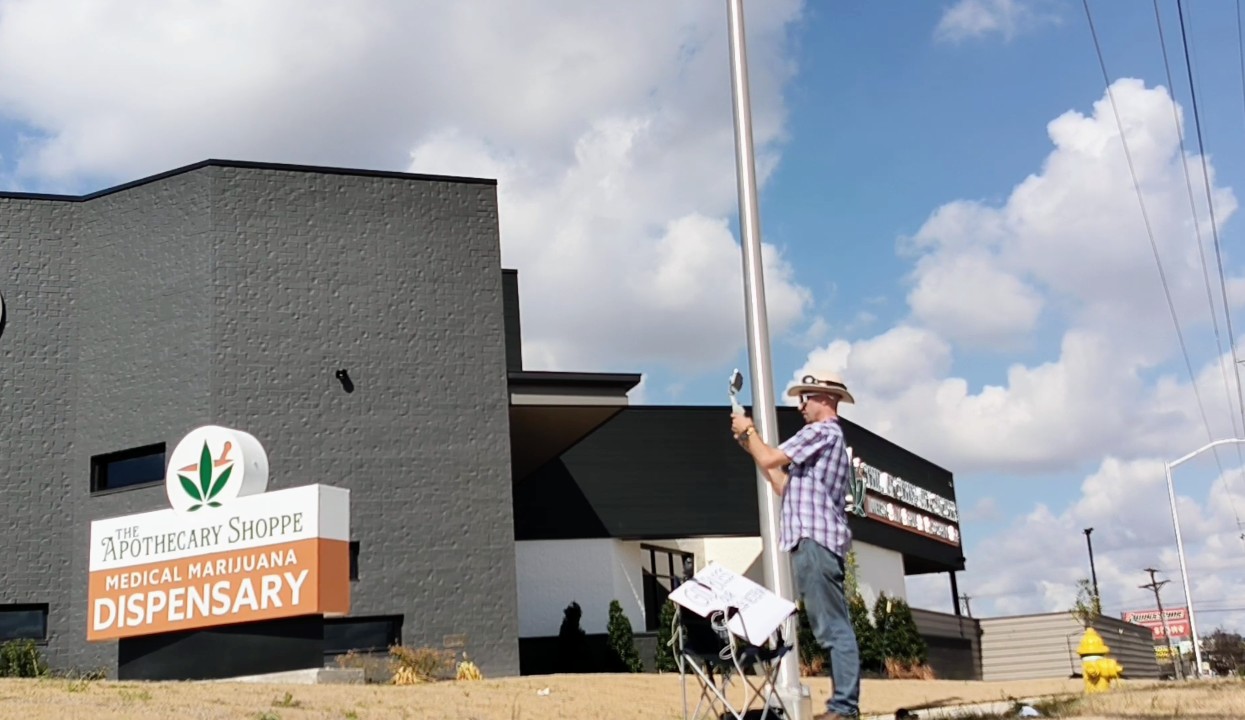
By Don Matthews | We The People News
On Sunday afternoon, February 8, 2026, a disturbing incident occurred at The Apothecary medical marijuana dispensary in Lafayette, LA involving a disabled United States Marine Corps veteran during an acute medical crisis. The facts are not in dispute. What happened was not loud, not chaotic, and not confrontational. It was quiet, procedural, and revealing.
Matthew Reardon, a Marine Corps veteran with service-connected PTSD, entered The Apothecary with a valid medical marijuana license that he has held since September 2025. This was his first time visiting this dispensary. He was not seeking recreational use. He was seeking prescribed medication during an active PTSD episode triggered by recent events connected to years of documented government misconduct, false charges, incarceration, and systemic retaliation.
Reardon calmly explained to the staff that he was experiencing severe PTSD symptoms and needed fast-acting relief. He asked for guidance on the most effective and cost-efficient option available because he had exactly $15 accessible on his Cash App account. He was transparent about his situation. He did not ask for free medication. He asked for help navigating a system that brands itself as medical.
The lowest-priced product available was a single pre-rolled joint priced at $12.50. At checkout, Reardon was informed that the dispensary does not accept tap-to-pay. He then attempted to pay using his Cash App card. At that point, staff advised him that their payment system only processes transactions in $5 increments, meaning the $12.50 purchase would be automatically rounded up to $15. He was then told that an additional $3.50 card-processing fee would be added on top of that amount.
Reardon explained—again—that he had access to exactly $15 and no more. He explained that this medication was necessary to manage his PTSD symptoms in that moment. He asked for a supervisor.
When the manager arrived, Reardon reiterated the situation clearly and respectfully. He requested a reasonable accommodation: any adjustment that would allow him to obtain the prescribed medication without being priced out by arbitrary rounding and discretionary fees. Options existed. The price could have been adjusted. The fee could have been offset. A managerial override could have been used.
Instead, the manager stated that nothing could be changed in the system. Staff suggested Reardon leave the dispensary, go across the street, purchase another item he did not need, and attempt to obtain cash back—an impractical and dismissive suggestion given his disclosed financial and medical condition.
At no point did Reardon raise his voice, threaten staff, or disrupt business. He did not record inside the store out of respect. He was there for medicine, not confrontation. Yet despite clear knowledge of his disability, his medical crisis, and his inability to absorb additional fees, the dispensary refused all flexibility.
This is not merely a customer service issue. PTSD is a recognized disability under federal and state law. Medical marijuana dispensaries that hold themselves out as medical providers are expected to make reasonable modifications to policies when rigid enforcement denies disabled patients equal access to prescribed treatment.
Reardon was not asking for charity. He was asking for accommodation.
What makes this incident particularly troubling is the context. Reardon has lost nearly everything due to years of government abuse, including false charges dating back to 2017, prolonged incarceration, and the seizure and sale of his personal property while he was jailed. Those same false records continue to disqualify him from employment through background checks, trapping him in financial precarity.
Against that backdrop, a medical dispensary chose strict adherence to payment mechanics over human judgment during a medical emergency.
After leaving the dispensary without medication, Reardon exercised his First Amendment rights by preparing to stand on a public sidewalk outside the business.
This article exists so that members of the public who encounter that sign understand exactly what it refers to.
We The People News encourages The Apothecary to preserve all surveillance footage and transaction records from the time of this incident. Transparency serves everyone.
Medical care is not defined solely by licensure or product type. It is defined by whether institutions recognize the humanity and legal rights of the patients they serve—especially when those patients are disabled veterans seeking relief during a crisis.
This report is factual, contemporaneous, and accurate to the best of our knowledge. Any party wishing to dispute the facts is encouraged to do so with evidence.
— Don Matthews Reporting on the experience of Matthew Reardon
Discover more from We The People News
Subscribe to get the latest posts sent to your email.
Breaking News
Exclusive: FBI database allegedly accessed by Red Cross shelter after man sought shelter during winter storm
At the center of the controversy is a question with implications far beyond one individual case: Are emergency shelters being used—intentionally or not—as gateways for law-enforcement screening, and are federal criminal databases being accessed outside lawful purposes during crises?

A winter storm emergency shelter publicly advertised as open to anyone—“no registration, no screening”—has now become the focus of a federal complaint alleging misuse of one of the United States’ most sensitive law-enforcement databases.
The incident occurred on January 24, during a period of freezing temperatures in Louisiana, when Lafayette Consolidated Government opened warming shelters for the public. Local media broadcasts emphasized that anyone needing warmth could simply show up. The shelter at issue was operated by the American Red Cross, a private humanitarian organization.
According to a formal report now submitted to the Federal Bureau of Investigation, events that followed raise serious questions about whether a federal criminal-justice database was accessed or leveraged after a private citizen sought shelter during the emergency.
From Humanitarian Aid to Law-Enforcement Action
The reporting individual states that he entered the warming shelter solely to escape freezing conditions, relying on public assurances that no identification, registration, or screening was required. He was not suspected of a crime at the time and was not informed of any law-enforcement involvement at the shelter.
Shortly thereafter, law-enforcement action was taken against him based on what was described as an “NCIC hit” connected to an unfinished or questionable warrant originating from New Orleans. The arrest was carried out publicly, and the individual was jailed.
The National Crime Information Center (NCIC) is a federal database operated by the FBI through its Criminal Justice Information Services (CJIS) division. Access is strictly limited to authorized criminal-justice agencies and may only be used for legitimate criminal-justice purposes. Private entities, including nonprofit organizations, are not authorized to access NCIC or request queries.
Legal experts note that even sworn law-enforcement officers may not lawfully access NCIC for non-criminal purposes, including background screening, risk assessment, or requests initiated by private parties.
Why Consent or “Safety” Does Not Apply
Federal law and CJIS policy are explicit: NCIC access is governed by statute and regulation, not by consent. Even if a private organization claims safety concerns or cooperation with police, those rationales do not authorize criminal-history checks outside a lawful investigative context.
Improper access or dissemination of NCIC data can trigger severe consequences, including administrative sanctions, loss of database access, and potential criminal exposure.
Missing Property and Escalating Harm
The situation escalated further after the arrest. According to sworn statements, the individual’s personal property was handled in two separate ways. While his jail property was inventoried, a backpack was seized separately by Lafayette Police and booked into the department’s evidence room.
When the backpack was later returned, his car keys were missing.
The keys had not been inventoried at the jail and were last known to be inside the backpack while it was in police custody. As of publication, the keys have not been returned, nor has any documentation been provided explaining their disappearance.
Despite this, city authorities have threatened to tow the individual’s vehicle for failing to move it—an action he says is impossible without the missing keys.
Civil-rights attorneys say towing a vehicle under such circumstances could constitute deprivation of property without due process and raise spoliation concerns if the vehicle is connected to disputed law-enforcement actions.
Federal Statutes Implicated
In his report to the FBI, the complainant states that the conduct described may implicate multiple federal statutes, including:
- 18 U.S.C. § 641 (misuse or conversion of government information),
- 18 U.S.C. § 1030 (unauthorized or exceeded access to protected computer systems), and
- 18 U.S.C. § 371 (conspiracy to misuse federal systems).
He emphasized that he is not making charging decisions but is reporting facts that warrant federal review.
A Broader Civil Liberties Question
At the center of the controversy is a question with implications far beyond one individual case: Are emergency shelters being used—intentionally or not—as gateways for law-enforcement screening, and are federal criminal databases being accessed outside lawful purposes during crises?
Civil-liberties advocates warn that blurring the line between humanitarian aid and law enforcement risks chilling people from seeking help during emergencies, especially unhoused individuals or those with past system involvement.
Emergency conditions, they note, do not suspend constitutional protections or federal data-access rules.
Public Record, Public Accountability
The FBI complaint was made contemporaneously creating a timestamped record before further enforcement actions—such as towing—could occur. The reporting individual has also issued formal preservation demands to prevent destruction or alteration of evidence.
As of publication, neither the American Red Cross nor local authorities have publicly addressed whether any NCIC query was run, who initiated it, or whether any federal criminal-justice data was accessed or shared.
What remains undisputed is the public promise made on January 24: that the warming shelter was open to anyone, with no screening.
Whether that promise was honored—and whether federal law was violated in the process—is now a matter of federal record.
Discover more from We The People News
Subscribe to get the latest posts sent to your email.
Audits and Encounters
Journalist returns to Galveston, TX to boldly confront Police and Officials over major corruption scandal in 2023

This was a False, Staged Arrest from the Very Beginning
On August 11, 2023, I was pulled over by the Galveston Police Department while commuting onto the island at approximately 2AM. What began as a traffic stop had in a very quick time turned into a DWI Investigation, with an arrest of me made on suspicion of DWI. Here is what is so bizarre. I was not under the influence of ANY substance or alcohol! I had touched neither.
From the moment the officers made contact, it was clear this was not a standard traffic stop. Galveston police claimed to smell alcohol coming from my vehicle. I immediately denied consuming any alcohol, stating I had not had a single drop in over 3 to 4 years.
Then they asked me to step out of my vehicle and perform a field sobriety test. I refused, explaining that these tests are notoriously rigged. Instead, I demanded a breathalyzer test—the most reliable, scientific way to prove my sobriety.
As a First Amendment Auditor, a Journalist, and a constitutional rights activist, I was recording the entire encounter. Two other journalists were also filming from a nearby location.
Despite my repeated demands for a breathalyzer, Galveston police insisted on a field sobriety test. Again, I refused, demanded an attorney, and reiterated my request for a breathalyzer test.
Instead of following standard procedure, the officers arrested me for suspicion of DWI, loaded me into the back of a truck, and transported me to the hospital for a blood test.
Even though they claimed the odor of alcohol was their probable cause, they refused to administer the breathalyzer test I repeatedly requested. Instead, they proceeded with a forcible blood draw, stating that they were applying for a warrant to take my blood sample.
However, I was never shown any warrant. Instead, nearly 10 officers forcibly restrained me while I was handcuffed behind my back. They stabbed my right arm multiple times with a needle in a forced blood draw—without any proof of intoxication or lawful justification.
This was brutal, unconstitutional, and illegal.
Afterward, they transported me to the Galveston County Jail.
The Conspiracy Against Me
While I was in booking, I overheard my arresting officer on a phone call with Deputy Kandi Beavers of the Lafayette County, Mississippi Sheriff’s Department.
I listened as Deputy Beavers allegedly conspired with the officer to charge me with a felony DUI third offense—despite the highly controversial nature of a previous 2021 DUI case involving her.
That 2021 DUI is still under appeal, as crucial evidence proving my innocence was “conveniently” lost before my November 2021 trial. CLICK THIS LINK to view my Appeal in MS Court of Appeals
For years, I have maintained that Deputy Beavers perjured herself on the stand, lying under oath to wrongfully convict me and send me to prison for a year in 2022.
So, when I was released from prison on August 1, 2023, I did exactly what anyone who has been wrongfully convicted and incarcerated due to someone else’s lies should do: I exposed her.
I released a video on August 2, 2023 proving that Kandace Beavers intentionally lied under oath in court, which resulted in my wrongful imprisonment for a year. This video can be seen by clicking here
And for that, she retaliated. Both her and Hoby James featured at the beginning of that video making the traffic stop on me. They tried to set me up once again in order to keep the truth suppressed.
This wasn’t just a routine traffic stop or arrest.
This was a coordinated, multi-state conspiracy involving:
- The Lafayette County Sheriff’s Department
- Deputy Kandace Beavers and Deputy Hoby James
- The Galveston Police Department
Recorded calls confirm that Beavers and James orchestrated this setup to have me arrested. They wanted me silenced because of my previous work exposing their corruption.
This Never Should Have Been a Felony
Even if I had been intoxicated while driving (which I wasn’t), this never should have been a felony. At most, it could have been a misdemeanor, but this was never about the law—it was about silencing me. This was a deliberate, targeted attack to try and put me back in prison by using Galveston law enforcement to do Lafayette County’s dirty work. Lafayette County needed me charged with a felony charge so they could revoke my probation and give me a much longer sentence than they could if I had been charged with a misdemeanor.
Lets examine Galveston Police Officer William Osteen
Now, let’s talk about Officer William Osteen—the corrupt Galveston Police officer who arrested me on August 11, 2023.
Officer Osteen’s bodycam footage shows one of the very first questions Officer Osteen asks Defendant is “You an auditor man?” (Ex. E, 02:48).
He then tells another officer “Hey, I’m doing this one, this is an auditor.” (Ex. E, 03:04-03:06).
After having less than a minute of conversation with Defendant, Officer Osteen later discusses with Officer Larry Murph how they can go ahead and arrest Defendant, stating he “can go off of slurred speech and the smell . . .” (Ex. E, 07:56-07:59). This clearly demonstrates Officer Osteen had already decided to arrest Defendant after less than a minute of interacting with him, before having made any significant observations.
Osteen claimed I was “Walking: Heavy Footed.” However, all video evidence shows the Defendant walking and standing normally. Officer Osteen had virtually no opportunity to observe Defendant’s walking prior to arresting him and obtaining the Warrant. (Ex. E, 09:44-12:38). The bodycam footage shows that Officer Osteen wasn’t even facing the Defendant for the brief period of time that Defendant was walking. (Ex. E, 09:44-10:11). Also, “heavy-footed” typically denotes slow, laborious movements,
but Osteen would later testify that Defendant was “extremely jittery.” (Ex. D, pg. 23, ln. 25).
In his Affidavit, Osteen claimed “Odor of Alcoholic Beverage on breath: Moderate.” The Toxicology Report revealed no trace of alcohol in Defendant’s blood. (Ex. B, pg. 1). “Moderate” is the second highest level of odor, and would not be present for a defendant with no alcohol in his system. Further, Officer Osteen clarified multiple times on camera that he did not smell alcohol on Defendant’s breath, only from his vehicle. (See, e.g., “Osteen Bodycam 1,” Ex. E, 09:35-09:39; “Osteen Bodycam 2,” Ex. F, 05:55-06:10). He would later testify under oath that once Defendant stepped out of his vehicle, he could not detect an odor of alcohol emitting from the Defendant. (Ex. D, pg. 24, lns. 1-5). Yet he still marked that there was a moderate smell of alcohol on Defendant’s breath in the Affidavit, an observation Officer Osteen had already demonstrated that he knew to be false.
Additionally in his affidavit for a blood warrant, Osteen marked “Refused to provide a sample.” Defendant clearly offered to take a breathalyzer test prior to being taken into custody, and consented to be taken into custody for that purpose. (Ex. E, 10:30-12:10). Officer Osteen had no probable cause to arrest Defendant at the point he took Defendant into custody, having smelled no alcohol nor observed any symptoms of intoxication, as described above. Officer Osteen would later testify that he did not suspect a substance other than alcohol, except that Defendant demonstrated a willingness to take a breathalyzer. (Ex. D, pg. 24, Lns. 11-21). However, being willing to take a breathalyzer is not a sign of intoxication which would justify a blood warrant, and Officer Osteen recorded only his alleged observations regarding alcohol consumption in the Affidavit. Officer Osteen intentionally omitted Defendant’s willingness to take a breathalyzer from the Affidavit so that he could use Defendant’s “refusal” as evidence supporting the Warrant.
Officer Osteen would later testify at the probation revocation hearing that Defendant’s “pupils were very small” and “he had pinpoint pupils” (Ex. D, pg. 24, ln. 10, & pg. 35, ln. 7). This is the exact opposite of the dilated pupils described in the Affidavit. Officer Osteen either did not get a good look at Defendant’s eyes and was just making something up in the Affidavit—a reckless disregard for the truth—or he changed his story and perjured himself once he discovered that the Toxicology Report revealed no trace of alcohol in Defendant’s blood.
Between the time of the Affidavit and the time of the probation revocation hearing, Officer Osteen changed the symptoms he claims to have observed from alcohol (slow, thick-tongued, slurred speech; dilated pupils; smell of alcohol on breath) to another substance instead (fast speech; small pupils; jittery movements). Each observation was made under oath, but they obviously aren’t both true. Such a fundamental shift in observations, under oath, suggests intentional misrepresentation rather than innocent mistake.
And here’s the real kicker: Osteen perjured himself twice in my probation revocation hearing, falsely testifying that my toxicology report showed alcohol in my system.
This is critical because without these false statements, there was no probable cause for my arrest.
Officer Osteen made these materially false or misleading statements knowingly and
intentionally, or with reckless disregard for the truth, in an attempt to set me up.
If you scroll to the bottom of my case docket, you’ll see that on February 25, 2025, my attorney, Ben Campagna, filed a motion for a Franks hearing.

What Is a Franks Hearing?
A Franks Hearing (based on Franks v. Delaware) is held when a warrant affidavit contains false statements or intentional omissions that mislead the judge.
If you remove the false information, there would be no probable cause for the warrant or the arrest.
That’s exactly what happened in my case.
The arrest warrant was based on lies.
And this isn’t just a minor mistake—this was deliberate perjury.
What is the next step?
If Galveston doesn’t drop this case immediately, I am demanding a trial ASAP.
Once this case goes to trial, everything comes out:
- The fabricated charges
- The corrupt police officers
- The illegal extradition
- The multi-agency conspiracy
If this case goes to trial, Officer Osteen will never be able to testify in court again. He needs to be criminally charged. I will be relentless in my pursuit of this along with identifying every single case that Osteen has ever testified as a witness on. I will ensure that the attorneys for each of these cases receives every last piece of evidence and an unconditional guarantee by me to be deposed and testify as a witness. I will demand, collectively, for each and every one of these cases to be reviewed.
This Is Bigger Than Me
If they can do this to me, they can do it to anyone.
This isn’t just about me—this is about precedent.
Every time they get away with violating someone’s rights, it empowers them to do it again and again and again.
And that’s why I’m fighting this.
Here is the 84 Page Franks Motion
Have you seen the new music video that exposes the corrupt state actors?
Discover more from We The People News
Subscribe to get the latest posts sent to your email.

Medical Dispensary Denies Disabled Marine Corps Veteran During PTSD Crisis

Exclusive: FBI database allegedly accessed by Red Cross shelter after man sought shelter during winter storm
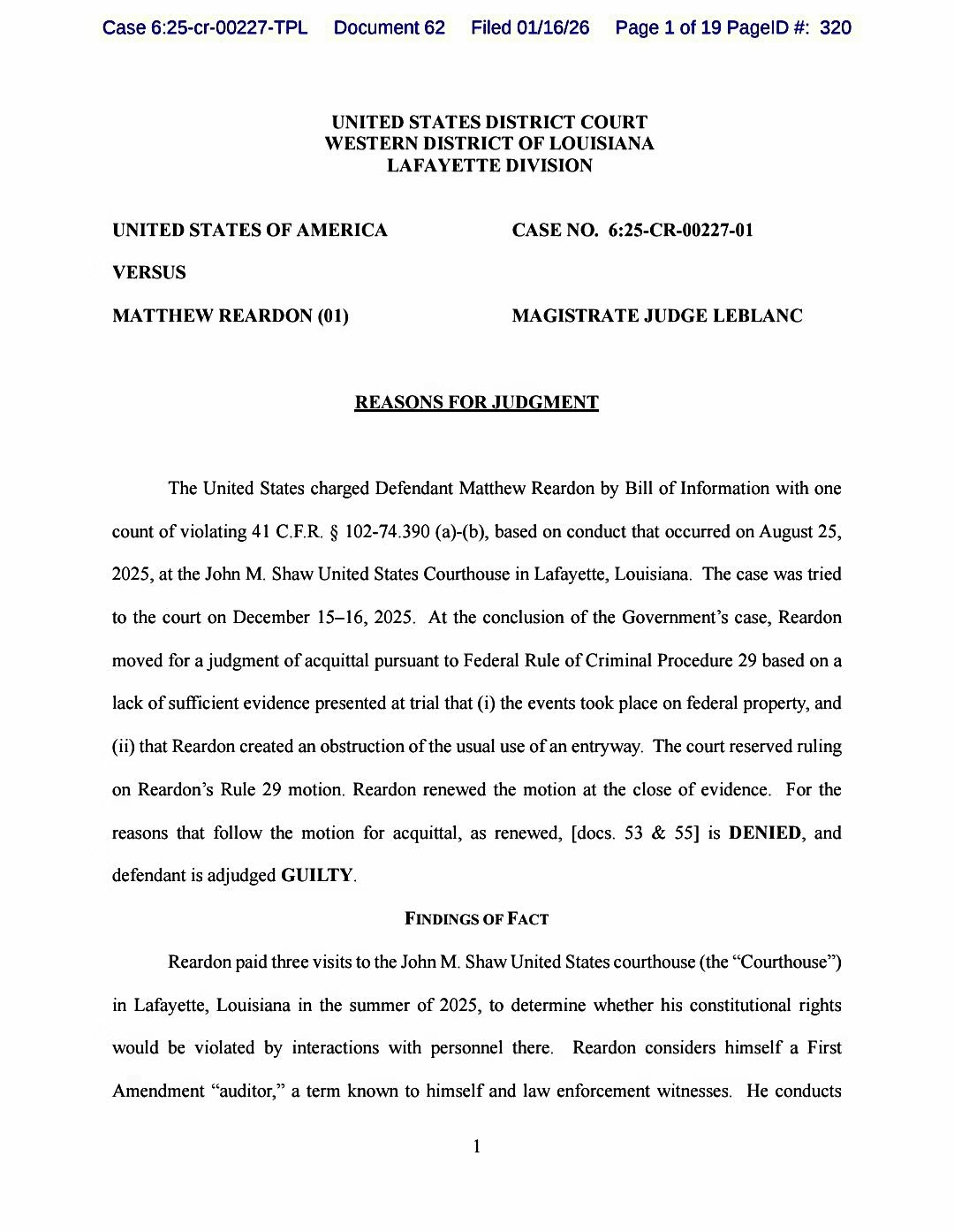
MAJOR VERDICT | How the Court Bent Law, Facts, and Time to Save the Government
Breaking News Alert! A Chilling Warning to All Citizens particularly Journalists & Reporters in North Mississippi
Staged DWI Arrest of Journalist Exposes Deep Government Corruption
New Song- False Witness
Journalist returns to Galveston, TX to boldly confront Police and Officials over major corruption scandal in 2023
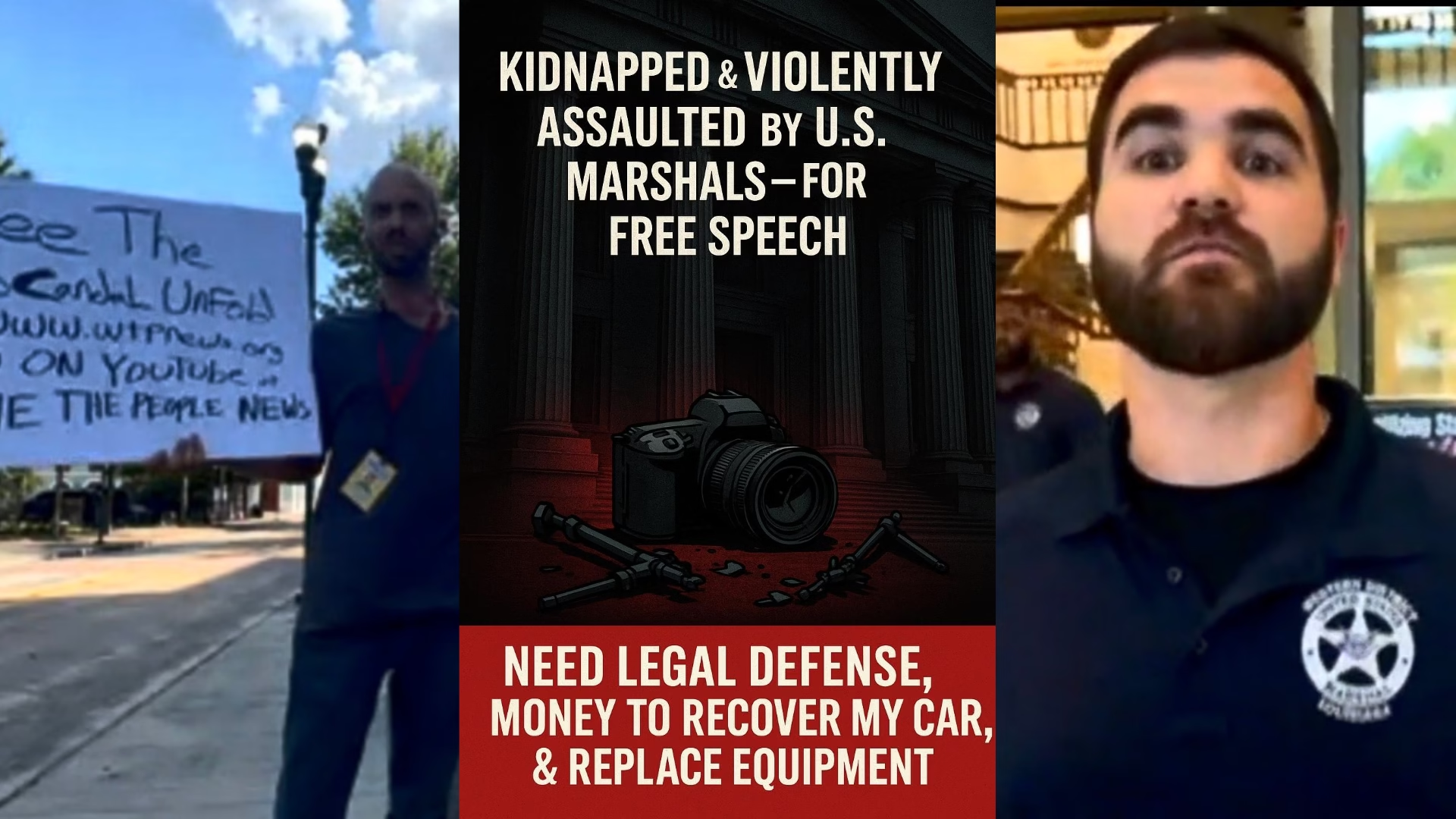
Journalist Violently Arrested for Protected Speech – WTPNews

State Trooper Assaults Journalist Outside Mississippi Governor’s Mansion in Viral Standoff
-
Breaking News4 years ago
Breaking News Alert! A Chilling Warning to All Citizens particularly Journalists & Reporters in North Mississippi
-
Audits and Encounters1 year ago
Staged DWI Arrest of Journalist Exposes Deep Government Corruption
-
Lafayette County Racket1 year ago
New Song- False Witness
-
 Audits and Encounters3 years ago
Victory for Transparency! Batesville, MS Reverses Controversial Ordinance Banning Video Recording in City Buildings
-
Breaking News2 months ago
MAJOR VERDICT | How the Court Bent Law, Facts, and Time to Save the Government
-
 Breaking News1 year ago
Attack on the Press: Journalist Trapped, Railroaded, and Imprisoned in Mississippi