
They split his head open. They charged him with a crime. They threw him in jail. They hid the evidence. And the District Attorney just confirmed what every document in this case already proved: it was all a lie.
The Orleans Parish District Attorney’s Office has officially refused to prosecute independent journalist Matthew Reardon — the man who showed up to New Orleans City Hall to do journalism and left in an ambulance — on every charge. The refusal code? “433 — Law Enforcement Issue.” Not insufficient evidence. Not uncooperative witnesses. A law enforcement issue. The cops are the problem.
A Journalist Walks Into City Hall. A Security Guard Splits His Head Open. The City Charges the Journalist.
On the morning of November 12, 2025, Matthew Reardon — an independent journalist and Marine Corps veteran — walked into New Orleans City Hall at 1300 Perdido Street to cover government proceedings. He had a cell phone, a gimbal, and a lighter and vape in his pocket. That’s it.
Security guard Jerome Ard of Allied Security told Reardon he could record in the public lobby but needed to pass through the scanner to go further inside. The wand flagged the lighter and vape. Ard said those items weren’t allowed in the building and Reardon could not enter.
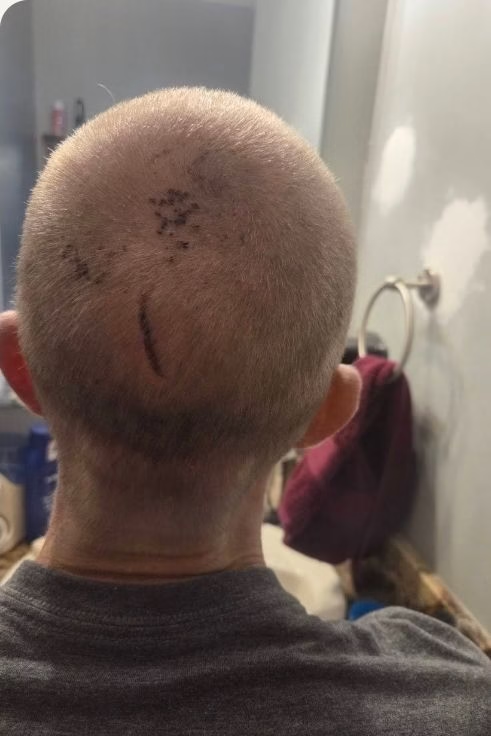
What happened next left a journalist face-down on the sidewalk, bleeding from a head wound, waiting for an ambulance.
The Official Story Collapses Under Its Own Weight
The arrest affidavit — sworn under oath by NOPD Officer Junious Grady — relies almost entirely on two Allied Security employees as witnesses: Wilfred Vidal and Willie Savage. Both work for the same company as Jerome Ard, the man who struck Reardon. Their story claims Reardon slapped Ard’s hands, shoved him, and that Ard “pushed” Reardon, who then “fell back and hit his head resulting in a small laceration.”
A “small laceration.” That’s what they called a head wound that required an ambulance ride and hospitalization at Tulane Medical Center.
But here’s what the affidavit admits — buried in its own pages: an RTCC (Real-Time Crime Center) technician reviewed City Hall’s security camera footage and confirmed the physical altercation happened outside the camera’s view. The cameras captured none of it. Zero.
So the entire basis for charging a bleeding journalist with a crime was the word of employees who work for the same security company as his attacker.
Officer Victor Paz (Badge #26091) looked at this — a hospitalized journalist, unverified witness statements from co-workers of the attacker, and no video evidence — and declared Reardon “the aggressor.”
The arrest warrant was signed by Judge Juana Marine Lombard at 3:34 PM that same afternoon. Same day. A journalist gets his head cracked open at a public building and by sundown, he’s the criminal.
Jerome Ard? The security guard who sent a journalist to the hospital? Never arrested. Never charged. Not that day, not any day since.
Two Months Later: Dragged From a Warming Shelter and Thrown in Jail
The warrant sat in the system like a loaded gun for more than two months.
On January 28, 2026 — during an ice storm rolling through Louisiana, with freezing temperatures across the state — Reardon was taken into custody. Not in New Orleans. In Lafayette, Louisiana — more than 150 miles away — while checking into a warming shelter run by the American Red Cross. He was held in Lafayette for approximately six days before being extradited to New Orleans, where he was booked at 2800 Perdido Street by Arresting Officer McIver (Badge #00625). The charge: simple battery. Bond: $100 cash.
One hundred dollars. That’s all it would have taken to walk out. But Reardon was told he couldn’t bond out without a Louisiana driver’s license.
There is no such requirement under Louisiana law. It doesn’t exist. It was a lie — or incompetence so profound it amounts to the same thing.
So Matthew Reardon — a man the DA would later determine should never have been charged — sat in Orleans Parish jail for two to three additional days while jail staff insisted he couldn’t pay his own bond. It took a supervisor finally stepping in to confirm what any first-year law student could have told them: you don’t need a state-issued ID from Louisiana to post bail in Louisiana.
The circumstances surrounding the arrest — during a winter storm, at a warming shelter — also raised serious concerns about potential misuse of the NCIC federal database, as previously reported by We The People News.
A Pretrial Services Public Safety Assessment completed the next day rated Reardon at Risk Level 1 — the lowest possible risk score in the system. His only prior: a 2014 DUI in Georgia. Zero felonies. Zero violent offenses. Zero failures to appear. The assessment recommended unsupervised release.
Dumped on the Streets — 150 Miles From His Car
When Reardon was finally released from Orleans Parish Prison, he was in New Orleans — roughly 150 miles and two-and-a-half hours from Lafayette, Louisiana, where his vehicle was parked. He had been hauled across the state for a charge that didn’t hold up to five minutes of prosecutorial scrutiny.
He was released to the streets with no transportation.
He waited approximately six hours for the next Greyhound bus back to Lafayette.
This is what the City of New Orleans did to a crime victim. Not a suspect. Not a defendant in any meaningful sense. A victim — one the District Attorney would later confirm should never have been prosecuted.
The DA’s Verdict: Every Charge Refused
On April 16, 2026, Assistant District Attorney Trishawn Payne-Jones screened the case — M625048 — against Matthew Reardon.
The decision, filed with the Orleans Parish Criminal District Court on April 17, 2026:
REFUSED. All charges refused.
Disposition code: 433 — Refused — Law Enforcement Issue.
Let that sink in.
Code 433 is not the code for weak evidence. It’s not the code for witnesses who won’t cooperate. It’s the code that means the law enforcement investigation itself is the problem. The DA looked at what NOPD built and concluded the foundation was rotten.
Officers Victor Paz and Junious Grady swore an affidavit under oath. They had a bleeding journalist on the ground, no camera footage of the assault, and nothing but statements from the attacker’s own co-workers — and they called the journalist the aggressor. The DA’s office has now told them, on the record, that their work product was the reason this case couldn’t be prosecuted.
They Charged Him — Then Used the Charge to Hide the Evidence
The story gets worse. It always does with this city.
On November 17, 2025 — five days after the assault — Reardon filed a formal public records request through the City of New Orleans’ NextRequest portal (Request 25-21253). He requested everything: all RTCC camera footage covering the entrance, lobby, and security area; all City Hall interior security camera footage; all 911 call logs, CAD entries, and dispatch audio; all incident reports, written statements, and security logs; all NOPD body-worn camera footage from responding officers; and all radio communications referencing the incident.
Here is what the City of New Orleans did with that request:
November 24: Reassigned from the City Attorney’s Office to Crime Cameras and 9-1-1. No records produced.
December 5: A form letter: “The City is working to determine if there are any records responsive to your request.”
December 10: The Law Department’s final response:
“Due to the limitations of Public Records Law, your request for RTCC footage and 911 calls concerning item number K-11205-25 cannot be fulfilled. Please be advised that records pertaining to pending criminal litigation or any criminal litigation which can be reasonably anticipated, until such litigation has been finally adjudicated or otherwise settled … shall not be disclosed. See LA RS 44:3(1).”
“All other documents must be obtained through the discovery process.”
Read that carefully. The City of New Orleans denied a crime victim’s public records request by citing the pending criminal case against him — a case the city itself created. They filed a warrant against the man who got his head split open in their building, then turned around and used that warrant as the legal basis to withhold the very footage that would show what happened.
They didn’t just charge the victim. They weaponized the charge to bury the evidence.
The remaining records — just the initial incident report — were offered only after payment of a $25 invoice, and even those were heavily redacted: names of witnesses blacked out, phone numbers removed, addresses erased, all citing privacy exemptions. The request was then marked CLOSED.
On December 9, Reardon called the City Attorney’s Office to challenge the denial. That call is now part of the public record.
A City That Cannot Find Its Own Victim Rights Program
In the days following the assault, Reardon made a series of recorded phone calls to every level of New Orleans city and police leadership — all of which are now public. What those calls reveal is institutional failure so complete it would be comical if a man’s civil rights weren’t hanging in the balance.
Nobody at NOPD knew about the Victim Witness Assistance Program. This is a program mandated by Louisiana state law — and it’s featured prominently on the NOPD’s own website. Reardon called the switchboard, multiple precincts, the Public Integrity Bureau, and 311. Not one person could explain what the program was or how to access it.
An NOPD call center employee: “We are offices here. And I’m not too familiar, and I tried to look it up in our contact list, and we don’t have any phone number for that.”
A 311 operator: “It could be a dead end with no, like, numbers.”
The Public Integrity Bureau — the division supposedly responsible for police misconduct — transferred him to a domestic violence detective’s voicemail.
Reardon warned them. During a call with Sgt. Davis of the NOPD Public Integrity Division, Reardon specifically warned that litigation would follow if the city attempted to frame its narrative around Reardon being the assailant in order to indemnify itself from civil liability. He told them exactly what would happen. The warning is on tape.
The city did it anyway.
The City Attorney’s Office played dumb. When Reardon called to report the assault and request records, a staffer named Tana Scoby stated: “We are not aware” of the incident — despite the fact that it happened in the lobby of the building where her office is located. The lobby. Of the same building. Where she works.
Questions That Demand Answers
The DA’s refusal does more than clear Matthew Reardon’s name. It detonates the entire narrative the city tried to build. And it leaves questions that New Orleans officials should be losing sleep over:
Why was Jerome Ard never arrested? By the officers’ own account, Ard pushed Reardon hard enough to crack his head open on the pavement. Reardon went to the hospital. Ard went home. No arrest. No charges. No consequences. To this day.
Why did NOPD officers charge the man who was bleeding? Officers Paz and Grady looked at a hospitalized journalist — a man taken away by ambulance with a head laceration — and decided he was the criminal. Based on what? Statements from the attacker’s co-workers and zero video evidence.
What are the consequences of Code 433? When the District Attorney tells you your investigation is the reason a prosecution can’t proceed, that’s not a technicality. That’s a finding. Officers Paz and Grady swore under oath. The DA said the investigation was the problem. What happens now?
Why is Allied Security still operating in a public building? A private security guard violently assaulted a member of the press at a public government building. The company has faced no public accountability. Allied Security’s contract with the City of New Orleans should be a matter of immediate public inquiry.
What happened to the RTCC footage? The city denied Reardon’s records request on December 10, 2025, citing the pending criminal case. That case has now been refused. The legal basis for withholding those records no longer exists. Where is the footage? Has it been preserved — or has it already been destroyed?
This Is What Happens When the Government Fears the Press
Let’s be clear about what happened here.
A journalist walked into a public building to cover public business. A private security guard, employed by a contractor operating inside a government facility, violently attacked him. The journalist bled. The journalist was hospitalized.
And then the City of New Orleans — through its police department, its courts, its City Attorney’s Office, and its public records apparatus — executed a coordinated response that at every turn treated the victim as the criminal:
- They charged him the same day, on an affidavit built on unverified witness statements from the attacker’s co-workers.
- They let the actual attacker walk free.
- They ignored his calls to every level of city leadership.
- They couldn’t find their own state-mandated victim rights program.
- They were warned about the consequences and ignored the warning.
- They arrested him during a winter storm and threw him in jail.
- They lied about bond requirements to keep him locked up longer.
- They dumped him on the streets 150 miles from his car.
- They weaponized the criminal charge to deny him access to the security footage.
- They closed his records request and called it done.
And when the District Attorney’s Office finally looked at the case, it took one screening to see through all of it.
Code 433. Refused. Law Enforcement Issue.
The Orleans Parish DA confirmed what the evidence showed from the very beginning: this case was never about what Matthew Reardon did. It was about what the City of New Orleans did — and what it’s still trying to cover up.
The question isn’t whether Matthew Reardon was vindicated. He was. The question is whether anyone in New Orleans will be held accountable for what was done to him.
We The People News has filed public records requests for all body-worn camera footage, RTCC footage, and internal communications related to this incident. With the criminal case now refused, the city’s legal basis for withholding these records no longer exists. This story will be updated as records are produced.
Matthew Reardon is the founder and editor of We The People News.
Recorded Phone Calls to City Leadership
- Call 1 — New Orleans Switchboard, November 2025
- Call 2 — Calling All Precincts
- Call 3 — Back to the Switchboard
- Call 4 — Inside New Orleans City Hall
- Call 5 — NOPD Public Integrity Department, November 14, 2025
- Call 7 — New Orleans City Attorney Office, November 14, 2025
- December 9 — Follow-Up Call with City Attorney’s Office
Related Coverage
- ASSAULTED AT CITY HALL: New Orleans Security Guard Violently Attacks Journalist, Destroys Evidence (Full Livestream)
- Jan 2026 — This Corrupt Pig Is About to Lose His Qualified Immunity
- Exclusive: FBI Database Allegedly Accessed by Red Cross Shelter After Man Sought Shelter During Winter Storm
🔗 Related Investigations
- EXPOSED: Journalist Assaulted at New Orleans City Hall, Left Bleeding — Then the City Arrested HIM and Covered It Up
- Attack on the Press: Journalist Trapped, Railroaded, and Imprisoned in Mississippi
- An Unconscionable Plan to Entrap and Falsely Imprison
📚 Legal Resources
- 42 U.S.C. § 1983 – Civil Action for Deprivation of Rights
- The Leadership Conference on Civil and Human Rights
Related Coverage
- Father Releases Emotional Dedication Song to Children, Calling It a “Blueprint to the Truth”
- BREAKING: Marine Veteran Files Emergency Federal Motions After Galveston Seizes Second Vehicle — Asks Judge to Intervene Immediately
- EXCLUSIVE: Galveston Steals Second Vehicle From Homeless Marine Veteran — City’s Towing Extortion Scheme Exposed
Legal & Records References
- Louisiana Public Records Act, La. R.S. 44:1 et seq.
- U.S. Const. amend. I — First Amendment (Cornell LII)
Discover more from We The People News
Subscribe to get the latest posts sent to your email.
Leave a Reply