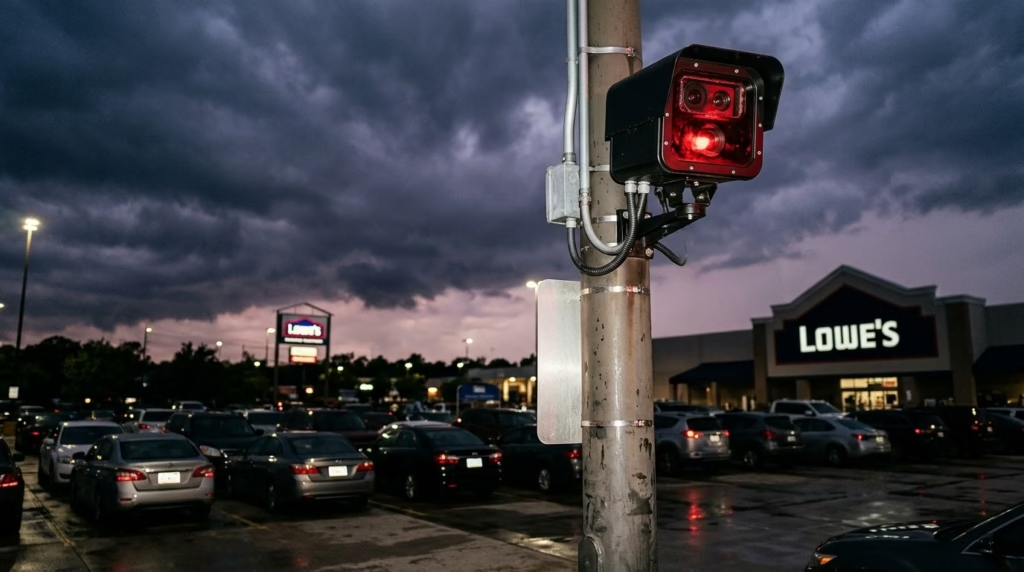
📹 PART 1: Don spots the Flock surveillance cameras at Lowe’s and starts documenting
Part I: What Happened at the Lowe’s in Batesville
I arrived at the Lowe’s in Batesville, Mississippi, with a camera, a protest sign, and the intention of showing my audience — live on YouTube — what a Flock camera looks like in the real world. I walked the perimeter. I counted three cameras: one at every entrance to the parking lot. Every way in and out, covered. Every license plate captured. Every customer logged. The store manager came outside almost immediately. He told me I was on Lowe’s property and ordered me to leave. I was standing on the curb of the public road — or on the grass easement immediately abutting it — a public right-of-way. This is the same strip of land where the City of Batesville recently constructed a “Welcome to Batesville” sign. If it were private property, the city would not have built public infrastructure on it. While the manager was pressing me to leave, a woman pulled up irate — not about the surveillance cameras recording her plate as she entered, but about a word on my protest sign. I pointed at the Flock camera behind me: “That is the biggest threat, not this word.” The manager was quick to side with her. He didn’t care about the cameras. He wanted me gone and the cameras out of the spotlight. The manager called the Batesville Police Department.📹 This entire encounter was documented live. Watch the full unedited livestream on YouTube →
📹 PART 2: First contact at the scene — what caused the wreck?
📹 PART 3: Here’s what all happened — and who’s responsible
📹 PART 4: Permanently trespassed from Lowe’s for exposing them
⚠️ UPDATE — April 18, 2026: The Receipts Are In
Courthouse Records Confirm Lowe’s Lied About the Property — And the City of Batesville Trespassed a Journalist From Public Land
After Lowe’s had me permanently trespassed for standing on what they claimed was their property, I did what any investigative journalist would do: I went to the Panola County Courthouse to pull the records. What I found confirms what I said from the beginning — and proves that Lowe’s and the Batesville Police Department were wrong.📹 FULL VIDEO: The complete courthouse investigation — 16 minutes of receipts
What the Records Show
At the courthouse, I requested GIS surveys and aerial mapping for the area where the “Welcome to Batesville” sign sits — directly in front of the Lowe’s location where I was trespassed. The Chancery Clerk directed me to the Assessor’s Office, where assessor Janie pulled up aerial photographs from January 2024. The property lines were clear:- Lowe’s owns approximately 13.1 acres — with deeds dating to 2003 and 2004 — and the strip of land where I was standing is not part of it.
- The area where I held my protest sign — the same area Lowe’s told police was “their property” — is part of the city right-of-way easement.
- The aerial maps confirm exactly what I said during the incident: “That right there… that was definitely easement. That’s 100% city property.”
📹 The key moment: Assessor confirms Lowe’s property line does NOT include the easement
Lowe’s Claim vs. Reality
During the original confrontation, Lowe’s claimed that because they cut the grass, the land was their property — and used that claim to have me trespassed indefinitely. The police accepted this at face value without verifying the property line. In fact, one of the officers admitted on camera that he couldn’t verify the property question because it was after 5 o’clock — yet the trespass was issued anyway. But here’s the problem with that logic: the City of Batesville erected its own “Welcome to Batesville” sign on that same strip of land. A city does not build public infrastructure on private property. The city’s own sign proves the land is public right-of-way.The bottom line: Lowe’s lied about owning the property. The Batesville Police Department enforced a trespass order based on that lie — without even verifying the property line. And I was indefinitely banned from city property for exercising my First Amendment right to protest on public land.
The Email to Mayor Ferrell
On April 9, 2026, I sent a formal email directly to Mayor Ferrell of Batesville. The subject line: “I Need You to Make This Right — Trespass Issued on City Property.” In that email, I laid out the facts and made two clear requests:1. Retract the trespass. It was issued from city right-of-way, not Lowe’s property, and it needs to be formally voided in writing. 2. A public statement — even a brief one — acknowledging that the officers on scene did not make the right call, and that the city does not stand behind the use of law enforcement to remove a citizen from public land for holding a protest sign.I gave the Mayor seven days to respond. I told him directly: “You know me. You know I’m not going away, and you know I’ll report the city’s response either way. I genuinely would rather you just do the right thing here.”
The City Hall Confrontation — April 8, 2026
The day before the email was transmitted, the Mayor of Batesville met me outside City Hall. I also briefly encountered the Chief of Police. What followed was recorded in full. A friendly conversation although something felt a bit off.📹 Watch the full City Hall encounter: Batesville Mayor meets with journalist outside City Hall →
📹 “Ratification & Confession” — Batesville Mayor and Chief of Police, April 9, 2026
Here are the key moments from that recorded exchange: The Mayor acknowledged my rights — then told me to tone them down:“Look don’t put cuss words on your sign man” “You got the right to do that. And I respect what you’re doing.”I asked the Mayor directly whether the city would address the Flock cameras:
Me: “Can the city of Batesville condemn the Flock cameras?” Mayor: “We don’t have Flock cameras… I don’t even think they’re working.” Me: “But Lowe’s does. They have one at each of the three entrances.”I explained that the trespass chilled my First Amendment right:
“All it takes is the chill — the threat of arrest. It chilled a right right there. So basically now, instead of me being able to freely exercise my right, I’m faced with a threat of arrest. Honestly, the officer made a bad call.”And when I asked the Mayor directly to rescind the trespass?
Me: “So y’all going to leave that trespass in place, or y’all going to Rescind it.” Mayor: “Well, no, we’re not going there right now.”The Mayor admitted receiving the email. He acknowledged my rights on camera. He admitted the officers didn’t verify the property line. And he still refused to rescind the trespass. Instead of correcting the wrong, the city made me do all the legwork — going to the courthouse, pulling the GIS records, proving what they could have verified with a single phone call.
The Silence Speaks Volumes
As of this writing, the Mayor has not formally responded to the email. The trespass has not been rescinded. No public statement has been issued. A corporation lied about a property line. Police enforced that lie without checking. A journalist was banned from public land for exposing surveillance cameras. When confronted with proof at City Hall, the city doubled down. When given a written opportunity to make it right, the city went silent. This is not just about Flock cameras anymore. This is about a system where corporations and local government work together to silence the people who ask questions.Part II: The Cameras Nobody Talks About
On August 6, 2025, the investigative outlet 404 Media published a bombshell: records obtained from the Johnson County, Texas Sheriff’s Office through a public records request by the Electronic Frontier Foundation (EFF) revealed that the sheriff’s office had access to Flock Safety license plate reader cameras at 173 different Lowe’s locations across the United States. The same records showed the office could tap into cameras — and gunshot-detecting microphones — at dozens of Home Depot stores within Texas. The cameras are not a rumor or a conspiracy theory. They are a documented, verified surveillance infrastructure embedded in the parking lots of two of the most-visited retail chains in the country. Dave Maass, director of investigations at the Electronic Frontier Foundation, put the implications in plain terms:“What we’re learning is that two of the country’s most popular home improvement stores are contributing to the massive surveillance dragnet coordinated by Flock Safety. Do customers know that these stores are collecting their data and sharing indiscriminately? Probably not. Have these companies given thought about how this data might put their customers in danger, whether it’s cops stalking their exes or aggressive ICE agents targeting yard workers? Probably not. If these companies want customers to feel safe in their homes, then they should make sure they’re also safe where they buy their supplies.”Maass wasn’t being hypothetical. He was describing documented cases that have already occurred.
Part III: The Machine
Flock Safety was founded in 2017 as a startup selling low-cost, solar-powered cameras to homeowners’ associations. Eight years later, it is a $7.5 billion surveillance empire — its September 2025 funding round led by Andreessen Horowitz — with nearly 90,000 cameras deployed across 49 states, integrated into more than 7,000 surveillance networks used by over 4,000 cities and 2,000 law enforcement agencies. In 2024, the company generated an estimated $285 million in revenue, up 70% year over year. Forbes has described its growth as “explosive.” Every camera in the system captures the license plate, vehicle make, color, and type of every car that passes. That data — tagged with a timestamp and GPS coordinates — uploads to Flock’s cloud servers, where it becomes searchable by any law enforcement agency in the sharing network. Police can query a specific plate and receive a map of everywhere that vehicle has been seen. No warrant is required. At current scale, Flock’s cameras scan license plates an estimated 500 million times per month. Agencies that subscribe can choose to share their data statewide or nationwide, meaning a sheriff’s deputy in rural Texas can, in seconds, pull the movement history of a vehicle from cameras in California, Virginia, or the parking lot of a Lowe’s in Mississippi. Private business clients like Lowe’s operate under what Flock claims are “more restrictive” sharing settings — but the 404 Media investigation proved those settings still grant law enforcement broad access across state lines. And now Flock is expanding beyond license plates. The company’s Raven product deploys always-listening audio sensors marketed for gunshot detection, but also capable of detecting “sideshows, fireworks, and other disruptive community activity” — a scope of ambient audio surveillance whose boundaries remain undefined. Home Depot stores in Texas were found to have Raven’s gunshot-detecting microphones alongside their Flock cameras. The company is also rolling out surveillance drones.Part IV: What the Data Has Actually Been Used For
The danger of mass surveillance is never theoretical for long. In December 2025, the EFF published its year-end investigation — the most comprehensive audit of Flock’s system to date — analyzing more than 12 million searches conducted by 3,900 agencies between December 2024 and October 2025. What they found was a system already in active misuse.Tracking Protesters
Agencies logged hundreds of searches tied to political demonstrations — the 50501 protests, Hands Off protests, and No Kings protests. Nineteen agencies conducted dozens of searches specifically targeting No Kings protesters alone. Delaware State Police queried the Flock network nine times in a single month to surveil members of Direct Action Everywhere, an animal-rights organization. Sometimes the searches explicitly referenced protest activity; other times, agencies used vague terminology to obscure that they were surveilling constitutionally protected speech.Targeting Romani People
The EFF’s audit uncovered searches including “roma traveler,” “possible g*psy,” and “g*psy ruse.” The Grand Prairie Police Department in Texas searched for the ethnic slur six times while using Flock’s “Convoy” feature — a tool designed to identify vehicles traveling together — effectively targeting an entire ethnic community without specifying any crime. According to a 2020 Harvard University survey, four out of ten Romani Americans report being subjected to police racial profiling.Immigration Enforcement Without a Warrant
ICE does not have a contract with Flock Safety. It doesn’t need one. According to data reviewed by 404 Media in May 2025, federal immigration agents have asked local law enforcement offices to search Flock cameras on their behalf — more than 4,000 times — giving federal agencies “side-door access” to a surveillance tool they don’t officially possess. The Virginia Center for Investigative Journalism reported that law enforcement conducted nearly 3,000 immigration-related searches on Virginia’s Flock network in a single twelve-month period. In Washington state, the University of Washington Center for Human Rights found that at least eight law enforcement agencies enabled direct sharing of their Flock data with U.S. Border Patrol, while Border Patrol searched the ALPR data of at least 17 Washington agencies — with Yakima County audit logs explicitly listing “ICE” as the stated reason for searches. When an ATF analyst improperly accessed Richmond, Virginia’s Flock system to aid an immigration investigation after individuals escaped an ICE detention center, the city’s police department blocked all federal access and confirmed the employee who authorized access was terminated. But Richmond was the exception. In most jurisdictions, the access continues unchecked.Surveilling Reproductive Healthcare
The EFF has documented that Flock’s system has been used to surveil women seeking reproductive healthcare. When cameras are positioned along roads leading to and from clinics, the data reveals who visits — and when. Because agencies share data across state lines, a prosecutor in a state that criminalizes abortion can query plate data from cameras in states where abortion remains legal. The EFF warned in a September 2022 analysis: “A prosecutor bent on prosecuting abortions can’t access your data if you don’t collect it.”Police Officers Stalking Their Partners
The ACLU documented a pattern of law enforcement officers weaponizing Flock’s tools for personal vendettas:- Lee Nygaard, the former police chief of Sedgwick, Kansas, used Flock cameras to track his ex-girlfriend’s vehicles 228 times over more than four months — and followed her and her new boyfriend in his patrol car.
- Michael Steffman, the former police chief of Braselton, Georgia, was arrested for allegedly using ALPR systems to stalk and harass multiple private citizens who were not under criminal investigation.
- Ryan Terrell, a lieutenant in North Charleston, South Carolina, admitted to using city-owned surveillance cameras to monitor his wife. He was not fired. He was demoted.
- Jarmarus Brown of the Orange City Police Department in Florida reportedly ran his girlfriend’s and her family’s plates over 100 times in seven months.
Part V: When the Machine Makes Mistakes
In testing by the surveillance industry research firm IPVM, Flock’s cameras misidentified a license plate’s state approximately 10% of the time. At 500 million scans per month, a 10% error rate is not a rounding error. It is a factory for wrongful police encounters. The human cost is already documented: Brittney Gilliam was driving to get her nails done in Aurora, Colorado, on a Sunday afternoon in August 2020. She had her daughter, her sister, and her young nieces in the car. Police pulled them over based on an ALPR hit indicating the vehicle was stolen. Officers dragged the family out at gunpoint, handcuffed all of them — including the children — and forced them to lie face-down on the pavement. The stolen vehicle was a motorcycle with Montana plates. Gilliam’s vehicle was an SUV with Colorado plates. The family is Black. Denise Green was pulled over late at night in San Francisco in 2009. Officers surrounded her car, ordered her out at gunpoint, and handcuffed her on suspicion of driving a stolen vehicle. Twenty minutes later, they realized the ALPR had misread a “3” as a “7” on her plate. Green is also Black. Flock’s cameras download fresh “hot lists” from the FBI’s NCIC database — a system the ACLU describes as “notoriously inaccurate” — only twice per day. That means a vehicle cleared from a stolen list can continue generating armed police encounters for up to twelve hours after the error is corrected.Part VI: The Legal Landscape
In 2024, a federal circuit court judge in Norfolk, Virginia, ruled that the mass collection of license plate reader data constituted a Fourth Amendment search requiring a warrant — the first ruling of its kind against Flock. The Institute for Justice filed a separate federal constitutional challenge against Norfolk’s Flock program. But in October 2025, the Virginia Court of Appeals reversed that ruling in Commonwealth v. Church, holding that because Flock cameras “simply took pictures of the license plate and [the defendant’s] vehicle as he drove it down public thoroughfares,” no warrant was required. Flock celebrated the decision, calling it the elimination of “the only adverse decision in the country related to the use of Flock’s LPR technology.” As of this writing, no court in the United States requires a warrant to access Flock’s surveillance network. Every appellate court to consider the question — two federal circuits, twenty federal district courts, and four state appellate courts — has ruled that scanning your license plate on a public road is not a search. The legal architecture of American privacy law has not yet caught up to a system that can reconstruct where you’ve been, who you’ve visited, what doctor you’ve seen, what church you attend, and what protests you’ve joined — all from the parking lot of a hardware store.Part VII: What Lowe’s Customers Need to Know
If you have shopped at a Lowe’s within the Flock network:- Your license plate, vehicle description, and visit timestamp were captured and uploaded to a cloud database.
- That data is searchable by law enforcement agencies across the country — potentially including ICE, Border Patrol, and agencies that have used the system to track protesters, target ethnic minorities, and surveil reproductive healthcare patients.
- You were never told. There is no sign at the entrance. No opt-in. No opt-out. No consent form. No privacy policy disclosure at the point of capture.
- Flock’s cameras have a documented 10% state misidentification rate. Innocent people — disproportionately Black Americans — have been detained at gunpoint, handcuffed, and forced to the ground because of these errors.
- Police officers have used this same system to stalk ex-partners, monitor spouses, and harass citizens with no connection to criminal investigations.
📹 PART 5: The full story — permanently banned for exposing Lowe’s dirty secret
What You Can Do
- 🛑 Stop shopping at Lowe’s and Home Depot until they publicly disclose and discontinue their Flock partnerships. Every purchase funds the infrastructure of your own surveillance.
- 📣 Demand answers from store management. Walk into your local Lowe’s and ask whether they have Flock cameras. Ask for the data retention policy. Ask who has access. Record the response.
- 📝 File a complaint with the FTC regarding deceptive data practices at ftc.gov/complaint. Lowe’s collects biometric vehicle data without disclosure — that may violate consumer protection statutes in your state.
- 🏛️ Contact your state legislators. Demand ALPR regulations requiring warrant-based access, mandatory public disclosure, opt-out rights, and strict data retention limits.
- 📲 Support the EFF and ACLU, which have led the investigative and legal challenges to Flock’s surveillance network.
- 🔄 Share this article. Corporate surveillance only survives in silence. Break it.
Support Independent Journalism
Don Matthews is an investigative journalist, First Amendment activist, and pro se civil rights litigant. He operates We The People News (WTPNEWS.ORG) and Patriot News Activism. Every claim in this article is sourced from published investigations by 404 Media, the Electronic Frontier Foundation, the ACLU, the University of Washington Center for Human Rights, the Virginia Center for Investigative Journalism, and federal and state court records. All footage of the Batesville incident is preserved on video. We The People News is 100% independent and viewer-supported. No corporate sponsors. No editorial interference. No agenda but the truth.- 💰 CashApp: $1Aaudit
- 💰 Venmo: @badactors
- 💰 Chime: $badactors
- 💰 PayPal: paypal.biz/wtpnews
- 📺 Subscribe on YouTube: We The People News
- 📱 TikTok: @wtpnews
- 📱 Facebook: WTP News
- 📸 Instagram: @wtpnewsnow
▶ WATCH THE FULL LIVESTREAM: Don Matthews documents Flock Safety surveillance cameras at Lowe’s in Batesville, Mississippi
🎵 The Music Behind the Mission
Don Matthews’ investigative journalism is only half the story. His album Bad Actors Volume 1 is a 17-track sonic case file documenting corruption across North Mississippi and the Southeast — including tracks like “Caught Red Handed,” “The Osteen Files,” and “Silence Ain’t Consent.” Every track tells a real story. Stream the entire album free.
🎧 Listen Free at BadActors.online →Related Articles from We The People News
- The Fabricated Felony: How Todd Lynch, Frank & Marlee’s, and Investigator Bundren Constructed an Impossible Criminal Charge
- The Oxford Machine: How Three Officials Built a System to Control Power, Bury $34,000, and Silence the Press
- Seven Days in March: Bond Threats, Legal Maneuvering & a Public Smear — The Complete Harvey Freebird–Matthew Reardon Text Record
- The Busby Files: Perjury, Fraud Upon the Court & Obstruction of Justice — An Evidentiary Dossier
- MAJOR VERDICT | How the Court Bent Law, Facts, and Time to Save the Government
🔗 Related Investigations
- “I Don’t Give a Rat’s Ass” — Mississippi Judge Uses Profanity From the Bench While Presiding Over a Public Profanity Trial
- EXPOSED: Journalist Assaulted at New Orleans City Hall, Left Bleeding — Then the City Arrested HIM and Covered It Up
- Download the Public Servant Questionnaire — 60+ Questions to Hold Government Officials Accountable
📚 Legal Resources
- 42 U.S.C. § 1983 – Civil Action for Deprivation of Rights
- The Leadership Conference on Civil and Human Rights
Related Coverage
- Federal Sentencing Set for August 7 in Lake Charles in Reardon Courthouse Case
- Father Releases Emotional Dedication Song to Children, Calling It a “Blueprint to the Truth”
- BREAKING: Marine Veteran Files Emergency Federal Motions After Galveston Seizes Second Vehicle — Asks Judge to Intervene Immediately
Legal & Records References
- Mississippi Public Records Act, Miss. Code Ann. § 25-61-1 et seq.
- Louisiana Public Records Act, La. R.S. 44:1 et seq.
- Texas Public Information Act, Tex. Gov’t Code § 552
- U.S. Const. amend. I — First Amendment (Cornell LII)
Discover more from We The People News
Subscribe to get the latest posts sent to your email.