
INVESTIGATIVE REPORT
By Matthew Reardon | We The People News | WTPNEWS.ORG | April 25, 2026A journalist walks into a Union County Board of Supervisors meeting to exercise his right to public comment. Five minutes on the clock. One question. One word. Then — handcuffs, a forceful arrest, and a phantom detainer with no legal basis. This is the full investigation.
The Trap Was Set Before I Opened My Mouth
Before I uttered a single word, the board issued a preemptive warning: any obscenity or vulgarity would result in immediate removal from the room. This wasn’t standard procedure. This was a setup.The defense argues in their legal filings that this preemptive warning was essentially a trap — like setting the rules of engagement specifically to silence a known critic before he could speak.The warning itself constitutes what First Amendment scholars call a prior restraint on speech — a government action that chills or prevents expression before it occurs. Prior restraints are the most constitutionally suspect form of government censorship, and for good reason: they allow officials to silence citizens preemptively rather than addressing actual disruption. The U.S. Supreme Court has held repeatedly that profanity alone, in the absence of genuine disruption, cannot be the basis for silencing a citizen at a public forum.
One Question. One Word. Arrested.
With my camera rolling — documenting everything — I began by asking for clarification on the record. Then I directly challenged the legality of the board’s newly announced gag rule. I asked one question:“How in the f— are you gonna tell me at a public meeting?”I didn’t finish the thought. I was immediately seized, arrested, and forcibly removed from the boardroom. My arms were aggressively wrenched and cuffed behind my back — despite the fact that I repeatedly and loudly protested a chronic, documented shoulder injury. I had been to the hospital three times in the preceding month for that same injury. The physical toll was significant. But the constitutional toll was worse.
Five Days Earlier: CJ Bright Confronts a Journalist on the Street
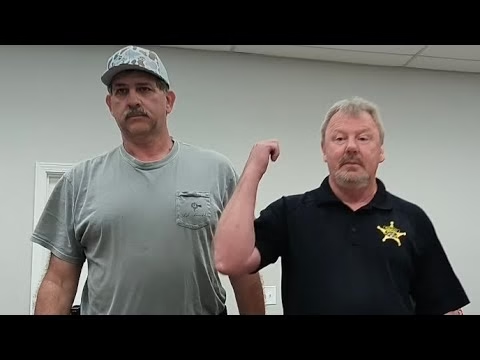
To understand what happened in that boardroom, you have to go back five days — to April 15, 2026. On that day, I was on a public sidewalk in New Albany conducting a First Amendment audit. I was live-streaming the entire protest on YouTube to my channel, We The People News. This was lawful, constitutionally protected activity in a traditional public forum. That’s when Union County Board of Supervisors President C.J. Bright pulled his vehicle over and personally confronted me on the side of the road. A sitting government official — the president of the board — directly intervened to challenge a journalist exercising First Amendment rights. But here’s the critical detail: Bright acknowledged on the street that he legally couldn’t stop me. He knew his hands were tied in a traditional public space. The First Amendment was clear, and he admitted it.That interaction set the stage for retaliation. Because Bright admitted on the street that he legally couldn’t stop Reardon in a traditional public space, Reardon decided to take his grievances directly to the Board of Supervisors meeting — to confront Bright officially and ask whether Bright was trying to curtail his speech.The move from the sidewalk to the chancery building was deliberate. If my rights couldn’t be violated on a street corner, the question became: would they be violated inside the boardroom? The answer came on April 20th. They were.
The Legal Mechanics of a Boardroom Arrest
The defense has compiled a massive body of evidence for this case: raw YouTube video transcripts, inmate release reports, officer affidavits, text messages, and a detailed memorandum of law. Their central argument is damning: Union County operated as if local ordinances could casually supersede federal civil liberties. The board’s obscenity rule functioned as a content-based restriction on speech in a designated public forum. Under established First Amendment law, the government cannot impose content-based restrictions in public comment periods unless they meet strict scrutiny — the highest standard of judicial review. A blanket ban on “vulgarity” does not survive strict scrutiny. It is not narrowly tailored. It is not the least restrictive means of maintaining order. And it was applied here not to prevent disruption — but to silence a specific critic asking a specific question.The Phantom Hold
After the arrest, the situation escalated beyond what any legitimate law enforcement action could justify. A detainer — a hold — appeared in the system preventing my release. But when the defense investigated, they discovered something alarming:There was no legal basis for this detainer to appear in the system. None. It was a phantom hold.According to the evidence, the origin of this unauthorized hold was explicitly admitted the following morning — April 24th — during my court appearance. The judge, upon hearing the constitutional arguments and facing the reality of this phantom detainer, immediately signed a release order, clearing the holds. But the damage was already done. The system “self-corrected” — but only after the local administration successfully used the machinery of government to detain a journalist for exercising constitutionally protected speech at a public meeting.
Watch the Full Deep Dive
The full investigation — including source documents, legal analysis, and the complete timeline — has been published on our YouTube channel:Video: THE DEEP DIVE — A Shocking Arrest & Massive Civil Rights Violation in Union County, MS
The Pattern Is Unmistakable
This is not an isolated incident. It follows a clear pattern of escalation:- April 15, 2026: CJ Bright confronts a journalist on a public sidewalk — then admits he can’t legally stop him
- April 20, 2026: The board issues a preemptive gag rule targeting the same journalist before he speaks
- April 20, 2026: The journalist is arrested for a single word during public comment — before completing his thought
- April 20-21, 2026: A phantom detainer with no legal basis is used to extend his detention
- April 21, 2026: A judge immediately releases him after hearing constitutional arguments
What the Law Says
Key Legal Principles at Stake:
- Prior Restraint: The government cannot preemptively restrict speech content at a public forum — even profanity — absent a compelling interest and narrow tailoring (Near v. Minnesota, Bantam Books v. Sullivan)
- Content-Based Restrictions: A blanket ban on “vulgarity” at a public meeting is a content-based restriction subject to strict scrutiny (Reed v. Town of Gilbert)
- Cohen v. California (1971): The Supreme Court held that the mere use of profanity is constitutionally protected expression — “one man’s vulgarity is another’s lyric”
- First Amendment Retaliation: Government action motivated by a citizen’s protected speech violates the First Amendment, even if the action is otherwise discretionary (Hartman v. Moore)
- Public Forum Doctrine: A board of supervisors public comment period is a designated public forum entitled to the highest First Amendment protections
The Questions Union County Must Answer
- Who authorized the preemptive gag rule at the April 20th meeting — and was it specifically designed to target a known critic?
- Who placed the phantom detainer in the system, and under what legal authority?
- Why was the arrest executed with such force against a person with a known, documented medical condition?
- Will CJ Bright be held accountable for his role in a pattern of confrontation, intimidation, and retaliation against a journalist exercising constitutional rights?
- Will the Union County Board of Supervisors rescind its unconstitutional speech restrictions at public meetings?
A Message to Every American
If they can arrest a journalist for one word at a public meeting — after preemptively setting a rule designed to trigger that arrest — they can arrest anyone. Your right to address your elected officials is not a privilege granted by a county board. It is a constitutional guarantee. And when that guarantee is violated, it is not just an attack on one person. It is an attack on every citizen who has ever stood at a microphone and demanded that their government answer for its actions.You can’t set a prior restraint on what a man could say. The First Amendment is not a suggestion. And the people you serve are watching.
Related Coverage
Support Independent Journalism
We The People News is 100% independent and viewer-supported. No corporate sponsors. No agenda. Just the truth.- 💰 CashApp: $1Aaudit
- 💰 Venmo: @badactors
- 💰 Chime: $badactors
- 💰 PayPal: paypal.biz/wtpnews
Related Articles from We The People News
- FOR IMMEDIATE RELEASE: Journalist Violently Arrested by Federal Agents for Protected Speech
- FBI Tried to Intimidate Me—So I Turned the Camera on Them
- Staged DWI Arrest of Journalist Exposes Deep Government Corruption
- The Fabricated Felony: How Todd Lynch, Frank & Marlee’s, and Investigator Bundren Constructed an Impossible Criminal Charge
- Union County Supervisor C. J. Bright Confronts Journalist During First Amendment Activity in New Albany
🔗 Related Investigations
- “I Don’t Give a Rat’s Ass” — Mississippi Judge Uses Profanity From the Bench While Presiding Over a Public Profanity Trial
- EXPOSED: Journalist Assaulted at New Orleans City Hall, Left Bleeding — Then the City Arrested HIM and Covered It Up
- NEW VIDEO: Galveston Police Officer Forgot He Swore an Oath to the Constitution
📚 Legal Resources
Related Coverage
- Reardon Files Objections to Magistrate’s Recommendation in Galveston Federal Civil Rights Suit
- Federal Sentencing Set for August 7 in Lake Charles in Reardon Courthouse Case
- Docket Update: Entry #89 Filed in Reardon v. Osteen et al. (2026-07-06)
Legal & Records References
- Mississippi Public Records Act, Miss. Code Ann. § 25-61-1 et seq.
- Louisiana Public Records Act, La. R.S. 44:1 et seq.
- U.S. Const. amend. I — First Amendment (Cornell LII)
Discover more from We The People News
Subscribe to get the latest posts sent to your email.
Leave a Reply