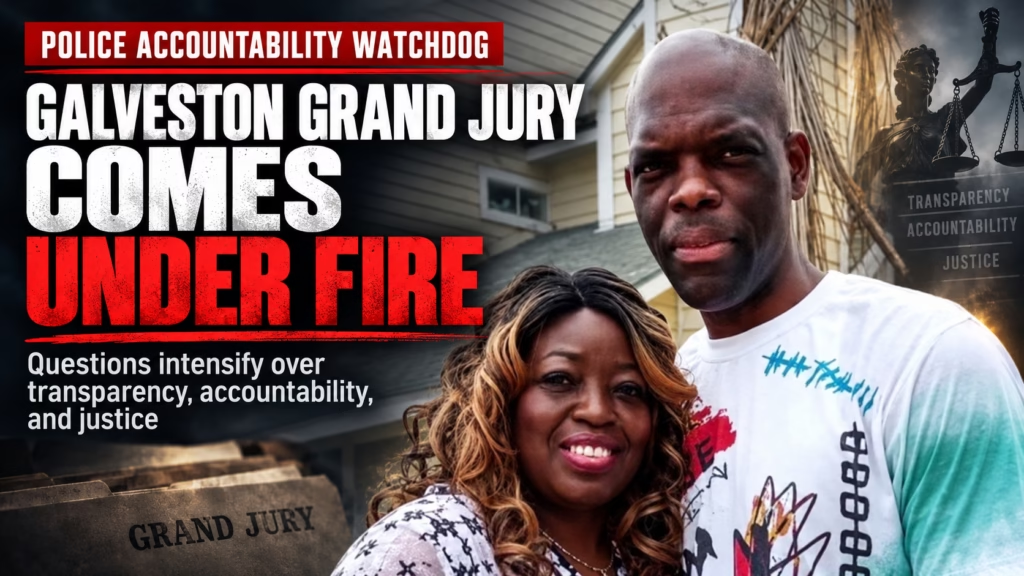
The case of Randy Martin is not an abstraction.
Martin, a 47-year-old Black man, was shot and killed by Galveston, TX Police Officer Joshua Nino de Guzman during a traffic stop on May 18, 2026. According to civil rights attorney Alberto Ruiz, who represents Martin’s family, Martin was unarmed. The shooting has been reported as de Guzman’s third fatal officer-involved shooting. Galveston Police Chief Doug Balli has publicly confirmed that de Guzman had been involved in two previous police shootings, and police have said he was cleared of wrongdoing in both.
After Martin’s death, the shooting was investigated by the Texas Rangers and eventually presented to a Galveston County grand jury. On September 8, 2026, the grand jury declined to indict de Guzman.
That decision matters beyond one officer or one shooting because of what happened on the other side of the same county justice system.
In my case, Galveston County obtained a felony DWI indictment after the government’s own laboratory reported that my blood contained 0.00% alcohol. I then remained incarcerated for approximately eleven months before the prosecution was ultimately dismissed.
The two cases are obviously different, and they were considered by different grand juries at different times. The issue is not that every police shooting should result in an indictment, nor that every criminal defendant who disputes a charge should automatically be cleared.
The issue is whether the same level of scrutiny follows the evidence regardless of who is being investigated.
When an ordinary citizen can be subjected to a felony prosecution despite objective laboratory evidence directly contradicting an officer’s claim that he smelled alcohol, while an officer reportedly involved in his third fatal shooting receives a no-bill, the public has legitimate reason to ask how those vastly different decisions were reached.
Grand-jury secrecy makes that question extraordinarily difficult to answer.
I do not know precisely what evidence was presented in either proceeding. I do not know how prosecutors characterized that evidence, which witnesses testified, what questions jurors asked, or what information may have been emphasized, minimized, or omitted.
And that is precisely why transparency matters.
Randy Martin’s family deserves access to the evidence surrounding his death to the fullest extent the law permits. They deserve to understand what happened during the encounter that ended his life and how the decision not to prosecute was reached.
The public deserves confidence that a fatal use of police force—particularly when the officer involved had already been involved in two previous police shootings—receives searching, independent scrutiny.
And I deserve to know how a felony DWI indictment was obtained after the government’s own laboratory found no alcohol in my blood.
These are not demands for predetermined outcomes.
They are demands for a justice system capable of demonstrating that the badge does not change the standard.
A grand jury should neither function as a rubber stamp for prosecution nor as a shield against accountability. Its legitimacy depends on evidence being treated consistently, regardless of whether the person under scrutiny is a journalist in handcuffs or a police officer carrying a gun.
That is the question Galveston County must ultimately answer:
Not simply why one man was indicted and another was not—but whether the same commitment to truth, scrutiny, and accountability was applied to both.
Discover more from We The People News
Subscribe to get the latest posts sent to your email.
Leave a Reply