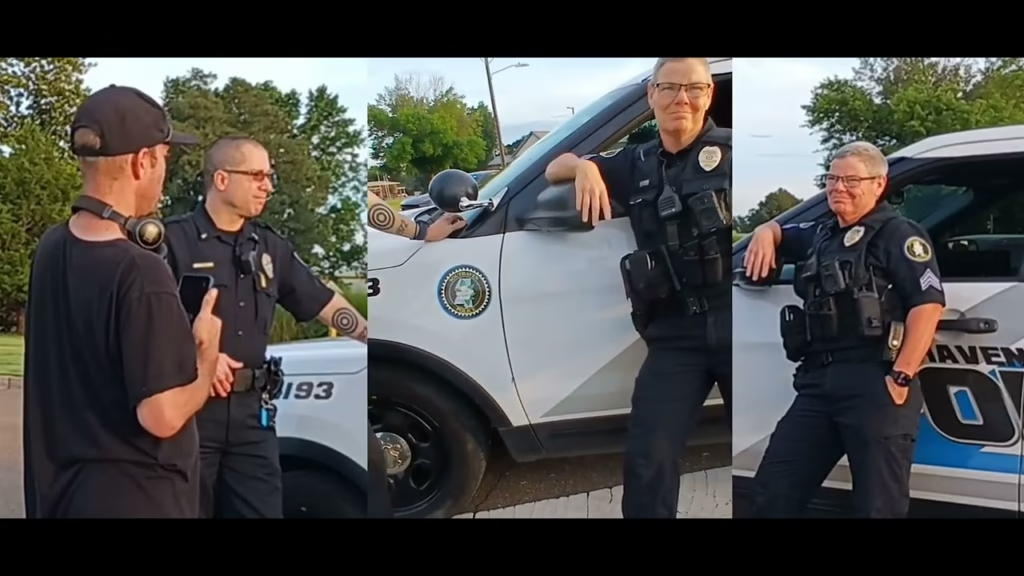
Southaven, Mississippi — A Marine Corps veteran and First Amendment activist stood on the public sidewalk outside Southaven City Hall, sign in hand, and did what no law can stop him from doing: he spoke freely. Within minutes, Sergeant Ward — badge 1513 — pulled her cruiser to the curb to inform him that people were complaining. What followed was a masterclass in constitutional ignorance, performative authority, and the kind of “rules for thee, not for me” policing that plagues departments across Mississippi.
Sergeant Ward Couldn’t Name the Five Freedoms She Swore to Protect
When Sergeant Ward stepped out of her cruiser, the encounter started predictably: a complaint about language. The activist held a sign that read “Fuck City Hall” — language the U.S. Supreme Court has protected for over fifty years. Ward’s response?
Sergeant Ward: “You can’t be out here cussing in front of people… We have a law. Public profanity.”
The activist, a U.S. Marine Corps veteran, pressed the sergeant on the most basic constitutional question an officer who took an oath should be able to answer:
Activist: “I swore a lifelong oath to protect and defend our Constitution. Y’all just said it and didn’t actually mean it, because I guarantee you, you know the First Amendment protects five things. Five things in specific… You can’t actually protect and defend something if you don’t know it. So, do you know the five things that the First Amendment protects?”
Sergeant Ward: “Please tell me.”
She didn’t know. She couldn’t name the five freedoms guaranteed by the First Amendment — religion, speech, press, assembly, and petition — yet she was prepared to enforce restrictions on one of them. This isn’t a gray area. This is a uniformed officer who took an oath to uphold the Constitution and can’t recite the most fundamental amendment she is sworn to protect.
“Have You Been Drinking?” — The Activist Flipped the Script
When the conversation didn’t go the way Ward expected, things took a bizarre turn. The activist asked Ward if she had been drinking:
Activist: “You been drinking today?”
Sergeant Ward: “Me?!”
Activist: “Yeah.”
Sergeant Ward: “I think I might smell, uh, just a little bit of alcohol coming off your breath. Are you sure you hadn’t been to the bar?”
The reversal was immediate and telling. When questioned by a citizen in the same way officers routinely question citizens, Ward was visibly thrown off — then deflected by accusing the activist of the same thing. It’s a textbook example of the superiority complex embedded in American policing: it’s acceptable for them to question you, but the moment the dynamic flips, it becomes an insult.
Then came an even more pointed moment. Ward asked the activist to take his hands out of his pockets “for her safety” — the exact scripted language officers use on citizens during stops every day. The activist turned it around on her:
Activist: “I tell you what, if you wouldn’t mind, uh, if you could just take your hand out of your pocket, just for my safety. Just for my safety.”
Sergeant Ward: “No.”
Activist: “No? All right.”
She refused. Of course she did. Because when the same demand is made of an officer, it feels absurd — yet citizens are expected to comply without question every single day. Rules for thee, but not for me.
And speaking of rules for thee — Ward wasn’t even wearing her seatbelt when she pulled up to the curb and stepped out. A law she would happily cite a citizen for breaking, but apparently one that doesn’t apply when you’re the one wearing the badge. The hypocrisy was visible before she even opened her mouth.
Lieutenant Borders Admitted the Speech Is Protected — Then Asked Him to Stop Anyway
Lieutenant Borders — badge 1525 — arrived shortly after. Unlike Ward, he acknowledged the obvious truth right away:
Lieutenant Borders: “I understand that — that word you’re saying is protected, right?”
Protected. He said it himself. But then, remarkably, he spent the rest of the encounter asking the activist to stop saying it anyway — not because it was illegal, but because of feelings:
Lieutenant Borders: “I’m just asking you not to cuss and scream and holler out here.”
Lieutenant Borders: “Just be respectful to ladies and kids, okay?”
Lieutenant Borders: “I’m asking you please respect that there are no children that are walking by here at this time of day at our park.”
The activist drove the point home with surgical precision:
Activist: “Did you take an oath to uphold and enforce the law or somebody’s feelings? Which one is it?”
Lieutenant Borders: “The law, obviously.”
Activist: “The law, obviously. So, you stopped right here to try to enforce somebody’s feelings.”
This exchange exposes the real problem. It isn’t about language. It’s about officers who know the law, admit the speech is legal, and still use the weight of their badge to pressure citizens into silence. When a lieutenant with over 20 years on the force openly admits a citizen’s speech is constitutionally protected and then asks him to stop — that’s not community policing. That’s soft coercion. That’s using the uniform as a tool of social control.
Enforcing Feelings, Not Law
The activist pointed out that when someone calls the station to complain about legal speech, the correct response is simple — and it doesn’t involve rolling a cruiser to the sidewalk:
Activist: “Your job at that point is to tell them, ‘No ma’am, well, it’s not against the law for him to do that. You may have a differing of opinion, you may not like it, but even the United States Supreme Court has ruled that you can just simply divert the eyes.’ Okay? That’s the answer to that — is to just simply tell them it’s not against the law. It’s not your job to go and do their bidding cuz you have a uniform and a badge on.”
He’s right. The Supreme Court’s guidance in cases like Cohen v. California (1971) is unambiguous: people offended by protected speech can look away. The remedy for offensive expression in a public forum is to avert your eyes — not to dispatch law enforcement.
Mississippi’s Profanity Statute Is Unconstitutional — And Everyone Knows It
Mississippi Code § 97-29-47 criminalizes the use of profane or indecent language in public. The activist was well aware of its history — and its constitutional infirmity:
Activist: “The Mississippi Supreme Court’s already ruled against it — even the state supreme court — saying that you can only criminalize vulgarity if it’s a fighting word, or sexually lewd — if it’s used in a sexual content, and it’s got to be very narrowly specific right there.”
He revealed that he already has a federal case pending challenging the statute:
Activist: “I’ve got a public profanity trial going on right now that’s generating a lot of attention. I’m trying to actually get another public profanity charge because I think that would be great for completely hammer-fisting the Mississippi statute on public profanity.”
When Sergeant Ward tried to define the law herself — “public profanity is when you’re using profanity in the presence of two or more people” — the activist corrected her immediately: “I promise you it’s not.” Because it isn’t. The statute, as broadly written, cannot survive First Amendment scrutiny, and every federal court that has examined similar statutes has struck them down.
A Pattern of Willful Ignorance
The activist noted that this isn’t the first time Southaven officers have made this mistake:
Activist: “I wish I remembered what the lieutenant that came out here and spoke to me about a couple of weeks ago. He said, ‘I’ve harped on this over and over and over again, my officers think that public profanity is just basically a catch-all.’ Oh no, you got to confine it a little bit. You can’t construe it so freaking broadly like that.”
The department’s own leadership has apparently tried to correct this. Yet here was Sergeant Ward — seven years in law enforcement, five with this department — telling a citizen that saying a word on a public sidewalk in front of City Hall is a crime. That’s not a training gap. That’s a culture problem. When leadership corrects officers repeatedly and the lesson doesn’t stick, the failure runs deeper than any in-service seminar can reach.
The Most Traditional of Public Forums
The activist wasn’t standing in a school. He wasn’t in a courtroom. He was standing on a public sidewalk outside City Hall — what First Amendment jurisprudence recognizes as the quintessential public forum:
Activist: “The most traditional of public forums is exactly where I’m standing right now. I don’t know if y’all are aware, but public sidewalk outside of City Hall earns 100% of the protections under the First Amendment. This is the safest ground that cannot be touched.”
He’s correct. The U.S. Supreme Court has repeatedly affirmed that public sidewalks are traditional public forums where First Amendment protections are at their zenith. Streets, sidewalks, and parks have been held in trust for public use and for purposes of assembly, communication, and public discussion since time immemorial.
The Sexism Angle Nobody Asked For
When Lieutenant Borders repeatedly invoked “ladies and children” as the reason the activist should self-censor, the activist called out the implicit sexism:
Activist: “I don’t know why we have to make it a sexist matter, why it has to be different for a, you know… What, can a female not have the same opinion as me?”
He also noted that no children had walked by during the entire encounter — a fact captured on his recording. The invocation of “women and children” as a reason to suppress speech is an old rhetorical device, and the activist saw through it immediately.
A Marine Corps Veteran Who Meant His Oath
What separates this encounter from countless others is context. This activist is a United States Marine Corps veteran who swore an oath to protect and defend the Constitution — and unlike the officers on scene, he can actually articulate what the Constitution says. He knows the five freedoms of the First Amendment. He knows the fighting words doctrine. He knows the Supremacy Clause. He’s already fighting a federal case over Mississippi’s profanity statute.
When he told the officers, “I didn’t just come out here by random — I’m an activist, I know the law, man,” he wasn’t bluffing. He was educating officers who couldn’t pass a high school civics exam on the rights they swore to protect.
Watch the Full Encounter
The Facebook copy of this video has garnered over 48,000 views in just over 24 hours with more than 1,100 reactions — proof that the public is paying attention, even if the Southaven Police Department isn’t.
We The People News is 100% viewer-funded. No ads, no sponsors — just accountability journalism. If this kind of reporting matters to you, consider supporting us at wtpnews.org/donate.
Discover more from We The People News
Subscribe to get the latest posts sent to your email.
Leave a Reply