ARRESTED AGAIN: Union County Sheriff Charges Journalist for Carrying a Protest Sign Into Public Buildings — A Direct Violation of Cohen v. California
Union County Sheriff arrests journalist Matthew Reardon for carrying a 'FUCK CITY HALL' sign into public buildings — the exact conduct the Supreme Court protected in Cohen v. California (1971).
By Don MatthewsJune 3, 2026Updated August 22, 2026
INVESTIGATIVE REPORT
By Don Matthews | We The People News | WTPNEWS.ORG | June 2, 2026
Six weeks after being arrested at a Board of Supervisors meeting for uttering a single profane word during public comment, journalist and activist Matthew Reardon has been arrested a second time in Union County, Mississippi — this time for carrying a protest sign into the Union County Justice Court and the county courthouse. The charge? “Disturbing The Peace.” The constitutional problem? The United States Supreme Court settled this exact question 55 years ago.
The Second Arrest: June 1, 2026
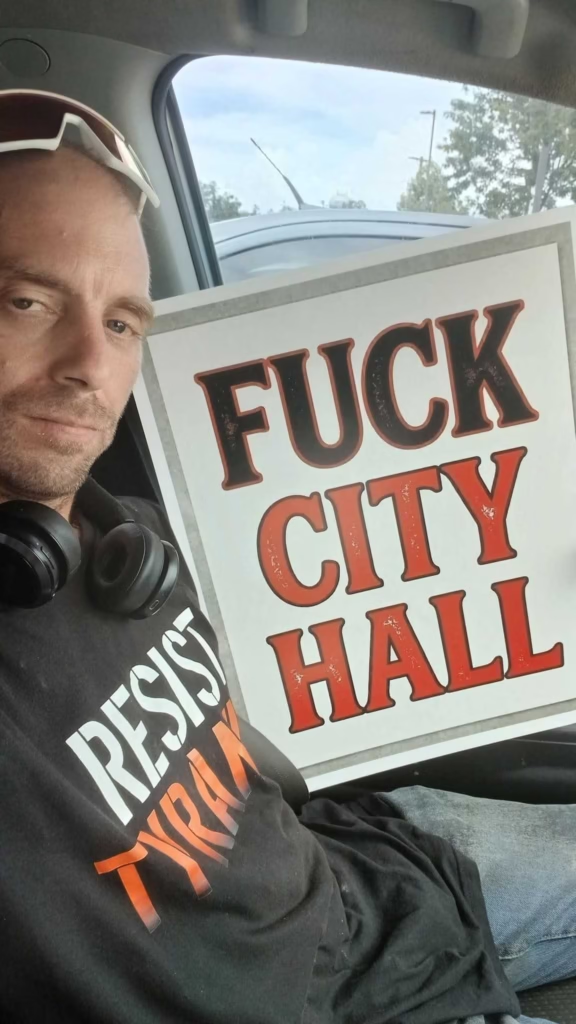
On the afternoon of June 1, 2026, Matthew Reardon walked into the Union County Justice Court building at 300 Carter Avenue in New Albany, Mississippi — a building shared with the Sheriff’s Department — during normal business hours. He was carrying a protest sign that read: “FUCK CITY HALL.” According to an affidavit sworn by Union County Sheriff Jimmy Edwards and filed before the Justice Court Clerk that same day, Reardon entered the building. The 300 Carter Avenue building houses both the Justice Court and the Sheriff’s Department on opposite sides of a shared lobby. Reardon first went to the Justice Court window, where he conducted legitimate court business with the clerk. He then walked across the lobby — past a water fountain — to the Sheriff’s Department side, where deputies sat behind a tinted window. It was there, speaking to sheriff’s deputies — not the Justice Court clerk — that Reardon asked about Investigator Adam Fitts and asked — pointedly — whether Fitts “had big enough balls to arrest him again.” He then went to the Justice Court window before leaving the building. But Reardon wasn’t done. He drove to the Union County Courthouse, walked inside with the same sign, and proceeded upstairs into the courtroom — still holding the sign, still exercising what the First Amendment guarantees every American citizen: the right to political protest. As Reardon entered the courthouse, an unidentified person inside the government building greeted him with: “Are you a fucking idiot?” — profanity directed at a citizen by someone inside the very building where that citizen would be arrested for displaying profanity on a sign. Reardon proceeded upstairs, where he encountered his procedural advisor Mark McClinton and showed him the sign. Within moments, Sheriff Jimmy Edwards intervened: “Stop him right there. You’re under arrest. You ain’t gonna do that here, man.” When McClinton asked what Reardon had done, the sheriff’s answer was telling: “He’s holding that sign up in the courtroom.” Not threats. Not violence. Not disruption. A sign. As Edwards physically arrested Reardon, the sheriff offered this: “You wanted it, you gonna get it.” — language that sounds less like law enforcement and more like punishment. When Reardon told the sheriff that the Supreme Court had already decided this exact issue in 1971, Edwards responded: “I don’t know that.” Reardon explained that Paul Cohen had worn a “Fuck the Draft” jacket into a courthouse. The sheriff’s reply: “Well, you are disturbing a building, man.” “Disturbing a building” is not a crime. It is not a statute. It is not a legal concept that exists anywhere in Mississippi law or any other jurisdiction in the United States. But it is what the sheriff of Union County said — on camera — as his justification for arresting a journalist exercising a constitutional right that the Supreme Court affirmed over half a century ago. The sheriff also offered a second justification: “They’re having Bible school across the street.” A religious program in a separate building, across a public street, with no connection to Reardon’s conduct inside the courthouse. This is not a legal basis for arrest. It is a sheriff reaching for any excuse after the fact. The charge: Disturbing The Peace, Mississippi Code § 97-35-13 — a misdemeanor carrying up to six months in jail and a $500 fine.
🎥 Watch the Arrest Video: The full incident — from Reardon entering the building to his arrest by Sheriff Edwards — was captured on video.
The affidavit notes that employees had been “notified on several occasions” about Reardon and were “fearful of what he might be capable of doing.” But the affidavit describes no threats, no violence, no physical confrontation. The only conduct described is carrying a sign and speaking words inside public government buildings.
In 1971, the United States Supreme Court decided Cohen v. California, 403 U.S. 15 — a case with facts so similar to Reardon’s arrest that it reads like a legal blueprint for his defense. Paul Robert Cohen walked into the Los Angeles County Courthouse wearing a jacket that said “Fuck the Draft.” He was arrested and convicted of disturbing the peace under California Penal Code § 415 — a statute remarkably similar to Mississippi’s § 97-35-13. The Supreme Court reversed his conviction. Justice John Marshall Harlan II, writing for the majority, held:
“Absent a more particularized and compelling reason for its actions, the State may not, consistently with the First and Fourteenth Amendments, make the simple public display of this single four-letter expletive a criminal offense.”
The Court’s reasoning was devastating to the government’s position — and it applies with full force to Reardon’s case:
It’s speech, not conduct. The Court held that the display of a profane word is constitutionally protected speech, not mere “conduct” that the state can regulate at will.
It’s not obscenity. Profanity used for political expression is not legally “obscene” — obscenity requires erotic or sexually explicit content.
It’s not fighting words. A sign held in a public building is not directed at any specific individual as a personal insult. “No individual actually or likely to be present could reasonably have regarded the words… as a direct personal insult.”
The government cannot be the taste police. Justice Harlan warned that allowing governments to ban specific words would let them use “the censorship of particular words as a convenient guise for banning the expression of unpopular views.”
“One man’s vulgarity is another’s lyric.” The Court recognized that the emotional force of language is part of its communicative power — and the First Amendment protects that force.
Mississippi Code § 97-35-13 criminalizes conduct in a public place that creates “a disturbance, or a breach of the peace, in any way whatsoever, including, but not restricted to, loud and offensive talk, the making of threats or attempting to intimidate, or any other conduct which causes a disturbance or breach of the peace.” On its face, this statute is broad enough to criminalize virtually any expression that makes government employees uncomfortable. But the First Amendment doesn’t bend to the comfort of government workers. (See also: “Enforce the Law, Not Feelings” — Marine Veteran Exposes Mississippi’s Profanity Statute) As the Supreme Court made clear in Cohen:
“The ability of government, consonant with the Constitution, to shut off discourse solely to protect others from hearing it is… dependent upon a showing that substantial privacy interests are being invaded in an essentially intolerable manner.”
Government employees working in public buildings do not have a privacy interest that overrides the First Amendment. A courthouse is not a private home. A justice court is not a corporate office. These are the people’s buildings, and citizens have a constitutional right to express displeasure with their government — even profanely — within them.
The May 5 Hearing: A Judge Loses Composure While a Pro Se Defendant Stands on the Constitution
Between the first arrest and the second, something remarkable happened in a Union County courtroom — and Reardon captured all of it on camera. On May 5, 2026, Reardon appeared in Union County Justice Court for a hearing on the original profanity charge. He had driven from Texas to Mississippi — after being denied the right to enter a not guilty plea remotely — at significant personal expense, all for a misdemeanor charge rooted in a single word. At that hearing, Reardon — representing himself pro se — filed a Strengthened Motion for Preliminary Injunction and Temporary Restraining Order, asking the court to:
Enjoin Union County, the Sheriff’s Department, and MDOC from arresting, detaining, or prosecuting him for protected speech;
Restrain all government actors from placing extrajudicial holds on him;
Order the State to identify all individuals who directed the unlawful MDOC hold — the unnamed “they” who ordered an MDOC officer to make Reardon “sit for a few days and think about his actions”;
Allow remote appearances for all future hearings.
The motion cited Cohen v. California, Elrod v. Burns, Chaplinsky v. New Hampshire, Reed v. Town of Gilbert, and over a dozen other federal cases. It laid out a devastating legal argument: that the arrest was retaliatory, the MDOC hold was an extrajudicial conspiracy, and the continued prosecution was chilling the First Amendment rights of every citizen in Union County. The courtroom video tells the rest of the story. As tensions rose during the hearing, the judge himself lost composure — at one point declaring on the record: “I don’t give a rat’s ass about that.” (Full WTP News coverage) Let that sink in: a judge used profanity from the bench during a hearing about whether a citizen can be arrested for profanity. Watch the Full May 5 Hearing (3 Parts):Part 1 — Tension Starts to Rise:
Part 2 — Temperatures Keep Rising:
Part 3 — Judge Loses Composure: “I don’t give a rat’s ass about that”:
The Court Was Warned — And Did Nothing
Here is the critical fact: Reardon told the judge — on the record, in open court — exactly what was going to happen. He filed a sworn motion demanding a restraining order against the sheriff. He told the court he intended to conduct a First Amendment civil rights investigation in Union County over the following weeks. He asked the court to restrain law enforcement from retaliating against him for exercising his constitutional rights. The court took no action. No temporary restraining order was issued. No preliminary injunction was granted. The motion was ignored. Twenty-seven days later, Sheriff Jimmy Edwards did exactly what Reardon warned the court he would do: he arrested Reardon again for exercising protected speech. The court’s failure to act didn’t just leave Reardon unprotected — it enabled the very constitutional violation the motion was designed to prevent. A judge who had been put on notice, who had the legal authority to restrain the sheriff, and who had a sworn motion before him demanding that protection, chose to do nothing. And a journalist paid the price — again.
A Pattern of Retaliation
This is not an isolated event. It is the latest in a documented, escalating campaign of retaliation against a journalist who has been publicly criticizing Union County officials:
April 15, 2026: Board of Supervisors President C.J. Bright personally confronts Reardon on a public sidewalk during a lawful First Amendment audit — then admits he cannot legally stop him.
April 20, 2026: The Board issues a preemptive “gag rule” banning profanity. Reardon is arrested for uttering one word during public comment before finishing his sentence.
April 20–21, 2026: A “phantom detainer” with no legal basis appears in the system, extending Reardon’s detention.
April 21, 2026: A judge immediately releases Reardon after hearing constitutional arguments.
May 5, 2026: Reardon appears in court after being forced to drive from Texas. He files a TRO motion demanding the sheriff be restrained. The judge takes no action — and uses profanity from the bench during a hearing about profanity charges.
June 1, 2026: Reardon is arrested again — this time for carrying a protest sign into public buildings. No violence. No threats. Just words on a sign.
When a government arrests the same critic twice in six weeks — each time for protected speech, each time with no violence — the word for that is not “law enforcement.” The word is retaliation. The Supreme Court has been equally clear on this point. In Hartman v. Moore (2006), the Court held that government action motivated by a citizen’s protected speech violates the First Amendment — even if the action is otherwise within the government’s discretion.
The Affidavit Speaks for Itself
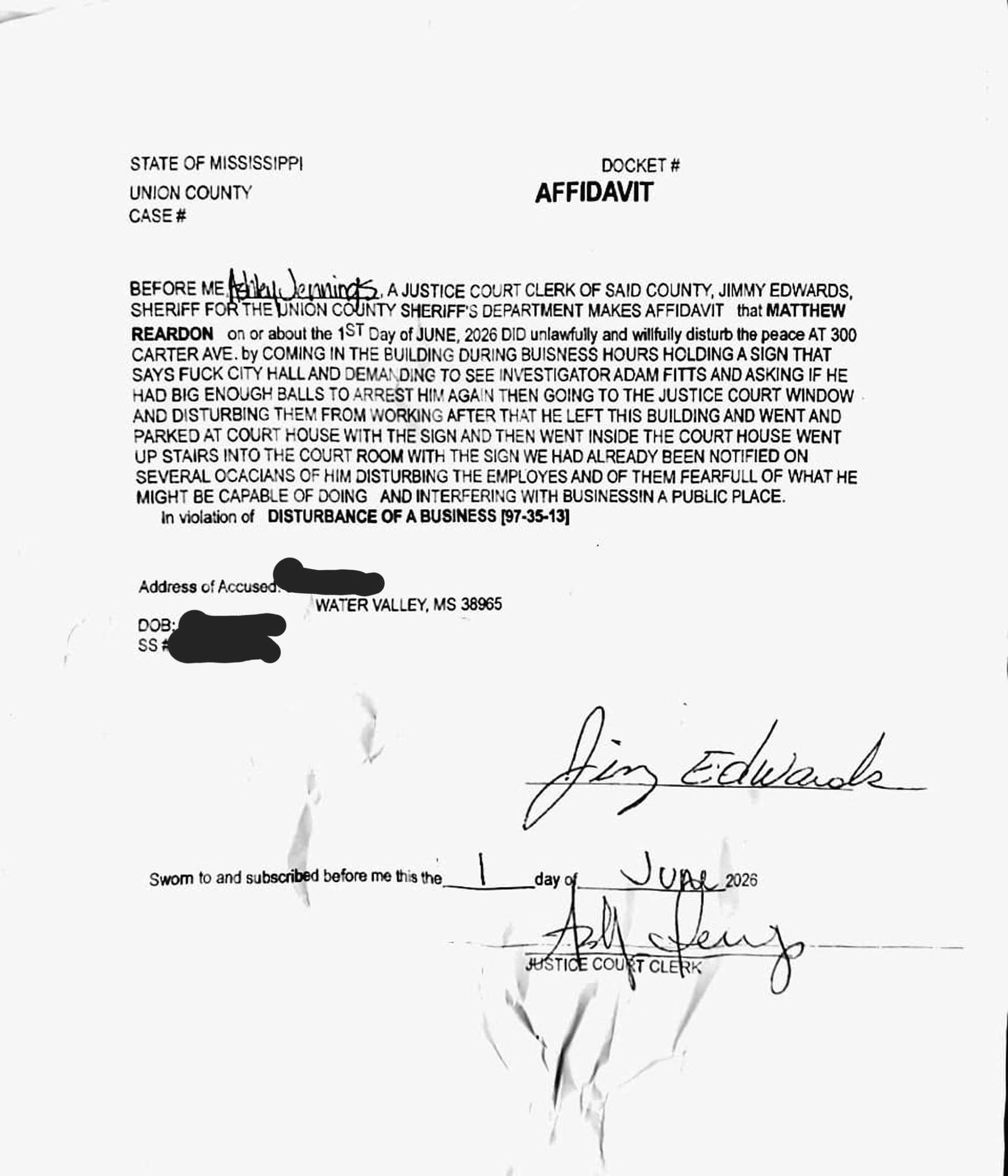
The sworn affidavit filed by Sheriff Jimmy Edwards on June 1, 2026 — charging journalist Matthew Reardon with “Disturbance of a Business” for carrying a protest sign into public government buildings. Read Sheriff Edwards’ affidavit carefully. It contains no allegation of violence. No allegation of threats. No allegation that Reardon touched anyone, blocked any doorway, or prevented any government function from occurring. The sum total of the alleged criminal conduct is:
Entering public buildings during business hours
Carrying a sign with a profane political message
Speaking to government employees
Asking a pointed question of the investigator who previously arrested him
Every single one of these acts is constitutionally protected.
A Document That Contradicts Itself
The affidavit cannot even keep its own story straight. In the body, Sheriff Edwards swears that Reardon “DID unlawfully and willfully disturb the peace.” But at the bottom, the formal violation line reads: “DISTURBANCE OF A BUSINESS [97-35-13].” “Disturbing the peace” and “disturbance of a business” are not the same thing — yet the sheriff apparently couldn’t decide which crime he was alleging on his own sworn document.
No Stamps, No Case Information
The affidavit has no docket number. No case number. No notary stamp. No clerk stamp. Both the “DOCKET #” and “CASE #” fields are left completely blank. This is a sworn legal document that was used to arrest and jail a United States citizen — and it lacks the most basic administrative identifiers required of any formal court filing.
Misspellings in a Sworn Legal Document
The carelessness extends to the language itself. In a single page, the sheriff misspells:
“BUISNESS” (business)
“OCACIANS” (occasions)
“EMPLOYES” (employees)
“FEARFULL” (fearful)
“BUSINESSIN” (business in — no space)
This is not a hastily scribbled field note. This is a sworn affidavit — a legal document submitted to a court of law to justify the arrest and detention of a journalist. The errors speak to the recklessness with which this arrest was executed.
“Demanding” vs. Reality
The affidavit’s language inflates every interaction. It claims Reardon was “DEMANDING TO SEE INVESTIGATOR ADAM FITTS.” The video shows Reardon casually asking a deputy behind glass whether Fitts was there — and being told he wasn’t. It claims Reardon was “DISTURBING THEM FROM WORKING” at the Justice Court window. The video shows a calm, polite conversation in which the clerk helps Reardon with routine case documents, asks “Is there anything else I can help you with?”, and Reardon thanks her before leaving. The affidavit also reveals something else: the sheriff admits that employees were “fearful of what he might be capable of doing.” But subjective fear — without any objective basis in actual threatening conduct — cannot constitutionally justify the suppression of political speech. If it could, every government critic could be silenced simply because their words made officials nervous.
The Video Evidence: What Actually Happened
Reardon recorded the entire encounter at the Justice Court building. The video — titled “Going to Union County Justice Court 6-1-2026” — does not depict a man creating a disturbance. It depicts a citizen conducting legitimate legal business while peacefully exercising his First Amendment rights. Before even entering the building, Reardon explains on camera exactly what he is doing and why:
“In 1971, Paul Cohen went into the courthouse wearing a jacket that said, ‘Fuck the Draft.’ He was arrested for disorderly conduct and the US Supreme Court overturned that and held that one man’s vulgarity is another man’s lyric. Here in 2026, Matthew Reardon will walk into the Union County Justice Court with a sign that says [fuck] city hall. Identical circumstances.”
This is not the statement of a man seeking to cause a disturbance. This is the statement of a man deliberately, knowingly, and peacefully creating the conditions for a constitutional test case — just as Paul Cohen did 55 years ago. What happens next on the video is equally telling:
[2:25] Reardon enters the Justice Court and greets the clerk politely: “Oh, hey. How — how are you doing?” / “Doing good.”
He asks about the sign. The court clerk responds matter-of-factly: “I see the sign.” — no alarm, no panic, no disruption.
[2:35] He immediately begins conducting legitimate legal business — requesting a copy of a recusal order from his pending case: “Hey, so I need to get the order of recusal from Garrison.”
The clerk goes to pull records. Reardon walks across the lobby — past a water fountain — to the Sheriff’s Department side, where deputies sit behind a tinted window.
He tells the deputy: “Fuck City Hall.” The deputy’s response? “That’s awesome.”
Reardon then asks about Investigator Adam Fitts — the man who arrested him the first time — and pointedly asks whether Fitts “wants to come arrest me for some trivial bullshit again.” He’s told Fitts isn’t there.
[3:08–4:33] Back at the clerk’s window, Reardon spends several minutes in a calm, detailed conversation about case documents, motions for recusal, and his procedural advisor Mark McClinton — asking whether McClinton had filed documents or even picked up case materials.
[6:48–8:28] He continues discussing his case status, asking about filed documents, which judges have recused, and court scheduling — routine legal business.
[8:28] Reardon tells the clerk: “Either way it goes, there needs to be honesty and communication.”
[11:10–11:43] Before leaving, he again explains the Cohen precedent to the court clerk: “In 1971, Paul Cohen wore a jacket into the courthouse saying ‘Fuck the Draft,’ was arrested for disorderly conduct. US Supreme Court reversed and said it’s unconstitutional, ‘one man’s vulgarity is another man’s lyric.’ So, in 2026, Matthew Reardon walks into the Justice Court, Union County courthouse with a similar message. And we’ll see…”
[13:07] He thanks the staff and leaves: “All right, thank you. All right. Fuck the government.”
At no point in the video does Reardon raise his voice, threaten anyone, block any doorway, interfere with any government function, or behave in any manner that could objectively be described as “disturbing.” He walks in with a sign, conducts his legal business, has polite conversations, and leaves. Yet the affidavit claims employees were “fearful.” The video tells a different story — the court clerk calmly acknowledges the sign with “I see the sign” and continues helping him with his case, while the sheriff’s deputy behind the glass responds to the message with “That’s awesome.”
The constitutional analysis here is not close. Under binding Supreme Court precedent:
Cohen v. California (1971) — The display of the word “fuck” on a sign in a government building is protected speech. Period.
United States v. Grace (1983) — Citizens have First Amendment rights on and around government buildings, including courthouses. The government cannot impose blanket bans on expressive activity in these spaces.
Reed v. Town of Gilbert (2015) — Content-based restrictions on speech are presumptively unconstitutional and subject to strict scrutiny.
Hartman v. Moore (2006) — Retaliatory prosecution motivated by protected speech violates the First Amendment.
Union County is not merely on shaky legal ground. It is standing on precedent that was demolished half a century ago.
The Sheriff’s Own Criminal Exposure
The question is no longer just whether Reardon’s speech was protected — Cohen v. California already answered that. The question now is whether the sheriff’s conduct in swearing this affidavit carries its own criminal consequences.
Federal law makes it a crime for anyone acting under color of law to “willfully subject any person… to the deprivation of any rights, privileges, or immunities secured or protected by the Constitution.” The penalty: up to one year in federal prison — or up to ten years if bodily injury results. A county sheriff who swears a materially misleading affidavit to arrest a citizen for conduct the Supreme Court declared protected over half a century ago is not enforcing the law. He is violating it — under color of the badge he wears.
Told the Law on Camera — and Chose to Ignore It
The § 242 analysis does not rest on speculation about what the sheriff knew. The arrest video captures the moment Reardon told Sheriff Edwards, directly and on camera, that the Supreme Court had already decided this exact issue:
Reardon:“Do you know this has already been decided in 1971?” Sheriff Edwards:“I don’t know that.” Reardon:“Paul Cohen wore a ‘Fuck the Draft’ jacket into the courthouse.” Sheriff Edwards:“Well, you are disturbing a building, man.”
The sheriff was informed of controlling Supreme Court precedent — by name, by facts, by year — and his response was to dismiss it and proceed with the arrest anyway. This exchange eliminates two critical defenses:
Qualified immunity is destroyed. Under Harlow v. Fitzgerald, 457 U.S. 800 (1982), government officials can claim qualified immunity only if they did not violate “clearly established” rights. Cohen v. California has been clearly established law for 55 years. The sheriff was told about it on camera and arrested Reardon anyway. There is no “I didn’t know” defense when the video shows the defendant explaining the law to you.
The “willful” element of § 242 is satisfied. Federal courts have held that “willfully” under § 242 means the officer acted with a “bad purpose” to deprive a person of a constitutional right. Being told the specific case law, dismissing it, and making the arrest anyway is not a mistake. It is a choice.
And the sheriff’s own words during the arrest — “You wanted it, you gonna get it” — do not describe an officer enforcing the law. They describe an officer administering punishment for constitutionally protected defiance.
The affidavit was “sworn to and subscribed” before a Justice Court Clerk. It is a statement under oath. When the sheriff wrote that Reardon was “DEMANDING TO SEE INVESTIGATOR ADAM FITTS,” the video shows Reardon casually asking a deputy if Fitts was there. When the sheriff wrote that Reardon was “DISTURBING THEM FROM WORKING,” the video shows a clerk calmly helping Reardon with case documents and asking, “Is there anything else I can help you with?” Mississippi’s perjury statute criminalizes willfully and corruptly swearing falsely. If the video contradicts the sworn affidavit — and it does — the question of who committed a crime on June 1, 2026 may need to be reexamined.
A Post-Hoc Justification, Not an Investigation
The affidavit does not read like the product of a law enforcement investigation. It reads like a narrative constructed after the decision to arrest had already been made. The sheriff’s own words betray this: “WE HAD ALREADY BEEN NOTIFIED ON SEVERAL OCCASIONS OF HIM DISTURBING THE EMPLOYES AND OF THEM FEARFULL OF WHAT HE MIGHT BE CAPABLE OF DOING.” This is not a description of what happened on June 1. This is a confession that the arrest was predetermined — that county officials had already decided Reardon was a problem, and they were waiting for a pretext. A law enforcement officer swearing an affidavit has a duty to investigate before seeking an arrest. The sheriff had deputies who witnessed the entire encounter firsthand. He had access to the video. He either failed to review the evidence before swearing under oath, or he reviewed it and swore to a version of events the video does not support. Neither option reflects the conduct of a lawful investigation.
In Franks v. Delaware, 438 U.S. 154 (1978), the Supreme Court held that when a defendant can demonstrate that an affiant deliberately or recklessly included false statements in an affidavit, the resulting arrest is constitutionally infirm. The standard is not whether the sheriff intended to lie — it is whether he acted with reckless disregard for the truth. When a sworn affidavit says “DEMANDING” and the video shows asking; when it says “DISTURBING THEM FROM WORKING” and the video shows routine legal business; when the document can’t even internally agree on what crime was committed — reckless disregard is not a stretch. It is the most charitable interpretation available.
The Questions That Demand Answers
Does Sheriff Jimmy Edwards believe that Cohen v. California does not apply in Union County, Mississippi?
Who instructed Edwards to pursue this arrest — and was it coordinated with other county officials who have a documented history of targeting Reardon?
Why does the affidavit lack basic case identifiers — no docket number, no case number, no notary stamp, no clerk stamp?
Did the sheriff review the video evidence before swearing his affidavit — and if so, how does he reconcile his sworn language with what the video actually shows?
Has a referral been made to the Mississippi Attorney General’s office or the U.S. Department of Justice Civil Rights Division regarding the sheriff’s conduct?
Will Union County taxpayers be forced to pay the inevitable civil rights judgment when this case is struck down?
How many more times will Union County arrest the same journalist for the same constitutionally protected activity before a federal court intervenes?
A Message from the Constitution
In 1971, Paul Robert Cohen walked into a Los Angeles courthouse wearing the word “fuck” on his jacket. The state arrested him. The Supreme Court freed him — and declared that the government cannot criminalize a word simply because it offends. In 2026, Matthew Reardon walked into a Mississippi courthouse carrying the word “fuck” on a sign. The state arrested him. The law hasn’t changed. The Constitution hasn’t changed. The only question is whether Union County, Mississippi will acknowledge that — or whether it will take a federal lawsuit to remind them. The First Amendment is not a suggestion. It is not optional. And it does not contain an exception for words that make sheriffs uncomfortable.
💰 CashApp: $1Aaudit 💰 Venmo: @badactors 💰 Chime: $badactors 💰 PayPal: paypal.biz/wtpnews Share this investigation with anyone who believes in the First Amendment, government accountability, and the power of citizen journalism.
Leave a Reply