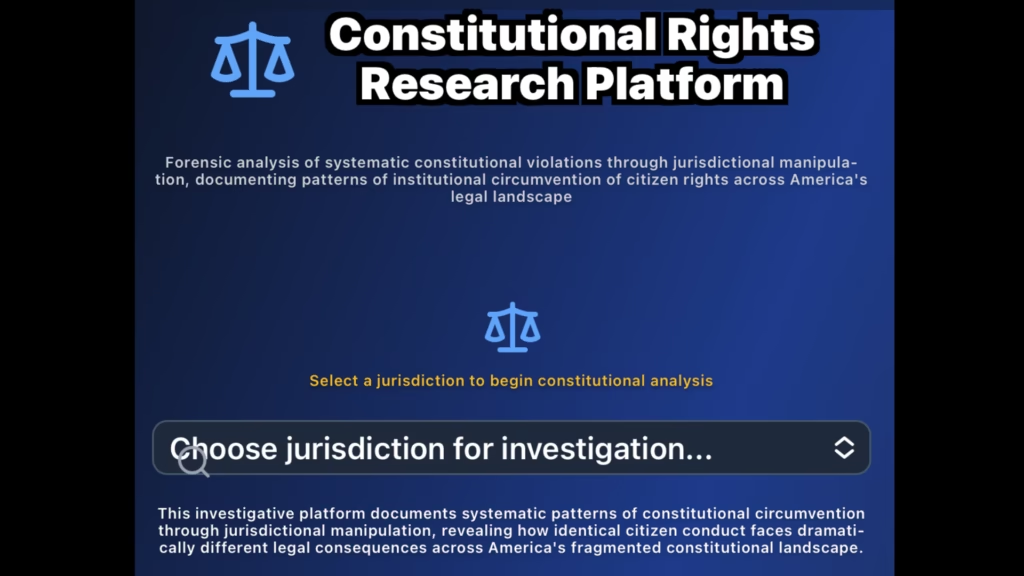
In this article I will discuss stop-and-identify statutes, citizen rights, and landmark First Amendment cases across all U.S. jurisdictions to support sophisticated civil rights legal practice. The analysis and research reveals a complex patchwork of state laws, constitutional protections, and evolving judicial precedents that civil rights attorneys must navigate in government accountability cases, First Amendment litigation, and citizen rights advocacy.
Constitutional framework establishes national baseline protections
The federal constitutional foundation provides critical standards that apply nationwide, though states may offer broader protections. Terry v. Ohio (1968) established the reasonable suspicion standard requiring “specific and articulable facts” for investigatory stops, while Hiibel v. Sixth Judicial District Court (2004) permits states to require identification during valid Terry stops only if statutory authority exists and providing a name wouldn’t be self-incriminating.
Brown v. Texas (1979) crucially established that presence in high-crime areas alone cannot justify reasonable suspicion, requiring officers to articulate specific observable conduct suggesting criminal activity. The Supreme Court has consistently distinguished between Terry stops (requiring reasonable suspicion) and voluntary encounters (where citizens remain free to leave and refuse identification).
First Amendment protections center on the public forum doctrine established in v bbb, creating different constitutional standards for traditional public forums (streets, parks), designated forums, and limited forums. The Brandenburg v. Ohio (1969) “imminent lawless action” test provides strong protection for political speech, while Near v. Minnesota (1931) establishes a “heavy presumption against” prior restraints on press coverage.
Recent constitutional developments include enhanced digital privacy protections following Carpenter v. United States (2018), growing circuit court recognition of the right to record police activities, and increasing constitutional scrutiny of government attempts to manipulate social media content moderation through indirect pressure.
State identification requirements create stark jurisdictional variations
Twenty-six states currently maintain stop-and-identify statutes requiring citizens to provide identification during lawful detentions based on reasonable suspicion. However, the scope, enforcement, and penalties vary dramatically across jurisdictions, creating significant strategic considerations for civil rights practitioners.
States with criminal penalties for identification refusal include Alabama (felony or public offense suspicion), Arizona (name only required), Delaware (up to 2-hour detention allowed), Florida (second-degree misdemeanor), Georgia (reasonable suspicion standard), Louisiana (criminal offense), Nebraska (reasonable suspicion with weapon search authority), Nevada (60-minute limit, historical Hiibel case), New Mexico (recent cases strengthening citizen protections), North Dakota (limited to serious offenses), Ohio (name, address OR date of birth), Texas (arrest situations only), and Utah (Class B misdemeanor with significant penalties).
States without stop-and-identify requirements provide stronger citizen protections, including all New England states except for limited provisions, most Mid-Atlantic jurisdictions, several Midwest states, and all Pacific states. Connecticut, Michigan, New Jersey, Pennsylvania, Virginia, West Virginia, North Carolina, South Carolina, Kentucky, Tennessee, Mississippi, Oklahoma, Illinois, Wisconsin, Minnesota, Iowa, South Dakota, Wyoming, Idaho, California, Oregon, Washington, Alaska, and Hawaii lack general identification requirements during police encounters.
Constitutional challenges focus on the reasonable suspicion standard, with citizens able to refuse identification when officers cannot articulate specific facts supporting criminal suspicion. State constitutional provisions in Montana, California, Alaska, and Hawaii often provide broader privacy protections than federal minimums.
Circuit court precedents reveal critical jurisdictional differences
Federal circuit courts have developed varying approaches to both identification requirements and First Amendment protections, creating strategic venue considerations for civil rights litigation.
The Fourth Circuit (Virginia, West Virginia, North Carolina, South Carolina) established strong protections in Wingate v. Fulford (2021), holding that police requests for identification outside valid Terry stops violate the Fourth Amendment. This precedent strengthens citizen rights across the circuit’s jurisdiction.
The Fifth Circuit has created dangerous precedent in McKesson v. Doe (2023), allowing civil liability for protest organizers based on “negligent protest” theories requiring only “foreseeability” of violence rather than the First Amendment’s intent-based incitement standard. This dramatically lower threshold creates severe chilling effects on protest organizing in Louisiana, Mississippi, and Texas, directly contradicting Counterman v. Colorado (2023), which explicitly rejected negligence standards for speech restrictions.
The Ninth Circuit (California, Oregon, Washington, Alaska, Hawaii, Montana, Idaho, Nevada) generally provides stronger protections for both identification refusal and First Amendment rights, including broader recognition of rights to record police activities and stricter reasonable suspicion interpretations.
Recent Supreme Court developments signal concerning trends for digital First Amendment protections. Free Speech Coalition v. Paxton (2025) represents a landmark retreat, upholding Texas age verification laws under intermediate rather than strict scrutiny, allowing 21+ states to require government-issued ID for accessing sexual content online. NetChoice v. Paxton (2024) confirmed platform editorial rights but TikTok Inc. v. Garland (2025)demonstrates the Court’s willingness to accept content-based restrictions under national security rationales.
State First Amendment precedents establish crucial civil rights foundations
Each jurisdiction has produced landmark First Amendment cases that civil rights attorneys regularly cite in practice. Brandenburg v. Ohio (1969) from Ohio established the “incitement test” protecting inflammatory political speech unless directed toward producing imminent lawless action. NAACP v. Alabama (1958) created fundamental freedom of association protections, while Near v. Minnesota (1931) established core prior restraint doctrine protecting press freedom.
Regional variations reflect different constitutional emphases: New England produced foundational cases like Chaplinsky v. New Hampshire (1942) defining “fighting words” doctrine, while the Mid-Atlantic generated Everson v. Board of Education (1947) applying the Establishment Clause to states. Southern states contributed Edwards v. South Carolina (1963) protecting civil rights demonstrations and Virginia v. Black (2003) distinguishing protected political expression from criminal threats.
Western jurisdictions developed digital age precedents including Pleasant Grove City v. Summum (2009) from Utah distinguishing government speech from public forums, and Counterman v. Colorado (2023) requiring subjective awareness for true threat prosecutions in online communications.
Recent enforcement trends reshape civil rights practice landscape
The 2024-2025 legal environment shows both strengthening protections and concerning restrictions that require strategic adaptation. Enhanced scrutiny of pretextual stops, growing state constitutional interpretation independent of federal minimums, and increased protection for recording police encounters represent positive developments.
However, age verification requirements in 21+ states create unprecedented identification requirements for accessing lawful speech online, with Free Speech Coalition v. Paxton signaling judicial acceptance of these restrictions. The McKesson doctrine in the Fifth Circuit poses severe risks for protest organizers, while digital surveillance technologies raise new Fourth Amendment challenges in police encounters.
State-level responses include California’s “No Secret Police Act” requiring law enforcement identification, enhanced body camera policies affecting stop documentation, and legislative reviews of existing stop-and-identify authorities. Federal oversight patterns show increased civil rights enforcement of constitutional violations while simultaneously accepting broader restrictions under child protection and national security rationales.
Practical strategic guidance for civil rights legal practice
Immediate tactical considerations require venue-specific strategies: avoid Fifth Circuit jurisdictions for protest organizer cases due to McKesson precedent, leverage state constitutional protections that exceed federal minimums, and document all police encounters with enhanced detail for Terry stop challenges.
Challenge identification demands by requiring officers to articulate specific reasonable suspicion, distinguishing voluntary encounters from investigative detentions, and asserting appropriate constitutional protections based on jurisdiction. Twenty-four states without identification requirements provide strongest citizen protections, while states with such laws still require proper reasonable suspicion foundations.
First Amendment litigation should emphasize platform editorial rights post-NetChoice to challenge government content manipulation, develop circuit splits on protest organizer liability standards, and file pre-enforcement challenges to age verification laws in favorable circuits. Anonymous speech protections face increasing pressure from identification requirements across digital platforms.
Long-term strategic priorities include building stronger precedents for minor digital rights before restrictions expand, establishing constitutional protections against algorithmic speech regulation, and developing alternative legal theories to counter dangerous Fifth Circuit precedents like McKesson.
Conclusion
This research reveals a constitutional landscape in significant flux, where traditional civil rights protections face new challenges from digital age enforcement mechanisms, expanded child protection rationales, and varying circuit court interpretations. Civil rights practitioners must navigate 26 different state identification regimes, multiple circuit court approaches, and rapidly evolving Supreme Court precedents that increasingly favor government authority over individual speech and privacy rights.
The most critical emerging threats include the Fifth Circuit’s protest organizer liability doctrine, widespread age verification requirements creating government identification infrastructure for accessing lawful speech, and judicial acceptance of intermediate scrutiny for content-based speech restrictions. Strongest protections remain in jurisdictions without stop-and-identify statutes, circuits with robust reasonable suspicion requirements, and states with independent constitutional interpretation exceeding federal minimums.
Success in civil rights practice requires mastering these jurisdictional variations, leveraging favorable precedents while avoiding dangerous ones, and adapting to a constitutional environment where traditional First and Fourth Amendment protections face unprecedented challenges from emerging government authority claims
Related Coverage
- Federal Sentencing Set for August 7 in Lake Charles in Reardon Courthouse Case
- U.S. Marshals Service and Department of Justice Exposed: FOIA Reveals #OperationSilenceThePress
- Morgan County Denies Journalist’s Public Records Request, Cites “Mailing Address” Requirement Not Found in Law
Legal & Records References
- Utah Government Records Access and Management Act (GRAMA), Utah Code § 63G-2
- U.S. Const. amend. I — First Amendment (Cornell LII)
Discover more from We The People News
Subscribe to get the latest posts sent to your email.
Leave a Reply