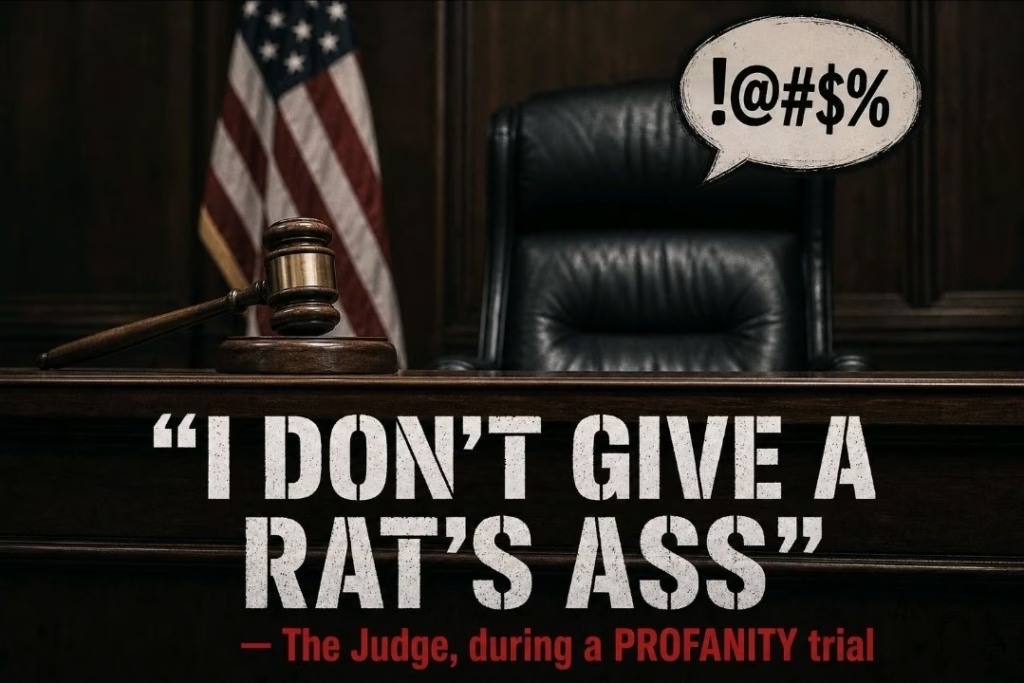
“I Don’t Give a Rat’s Ass” — Mississippi Judge Uses Profanity From the Bench While Presiding Over a Public Profanity Trial
A Union County Justice Court judge dismissed the Supremacy Clause of the United States Constitution with a vulgarity — during a hearing for the crime of being vulgar. If this isn’t proof that Mississippi’s public profanity law is unconstitutionally vague and selectively enforced, nothing is.I. The Irony That Broke the Case Wide Open
On May 5, 2026, inside the Union County Justice Court in New Albany, Mississippi, independent journalist and First Amendment auditor Matthew Reardon stood before a judge to face a criminal charge under Mississippi Code §97-29-47 — Public Profanity. The charge: Reardon had used a profane word during public comment at a Union County Board of Supervisors meeting. What happened next should end this case — and this law — permanently. When Reardon raised the Supremacy Clause of the United States Constitution — the bedrock legal principle that federal constitutional protections override state and local laws — the presiding judge responded from the bench:“I don’t give a rat’s ass about that.”Read that again. A judge presiding over a public profanity trial used profanity from the bench. In open court. On the record. If the judge himself cannot maintain the standard the law supposedly requires — in his own courtroom, during the very proceeding meant to enforce that standard — then the law is, by definition, too vague for any type of enforcement that is even remotely constitutional. This isn’t just irony. It’s the case imploding on itself.
II. The Arrest: A Word at a Public Meeting
The prosecution of Matthew Reardon began at the Union County Board of Supervisors meeting on April 20, 2026. Reardon, exercising his right to address his elected officials during a public meeting — a quintessential First Amendment activity in a designated public forum — used a profane word. Body camera footage obtained from the incident reveals a disturbing sequence that goes far beyond a reaction to a single word:- Agenda manipulation — evidence suggests the meeting was structured to limit or control public comment
- Targeted speech restriction — Reardon was singled out for speech policing while others were not
- Deliberate provocation test — officials appeared to be testing how far they could push to create a basis for enforcement
- Immediate physical force — Reardon was physically removed from the meeting
- Instant business resumption — the meeting continued immediately after Reardon’s removal, suggesting no actual disruption occurred
III. The Constitutional Avalanche: 9 Motions, 32 Supreme Court Cases
At the May 5, 2026 hearing, Reardon — representing himself pro se — arrived not with an apology, but with a legal arsenal. He filed nine separate motions challenging every dimension of the prosecution:1. Motion to Dismiss (8 pages)
Raises 10 independent constitutional grounds for dismissal, including violations of the First, Fourth, and Fourteenth Amendments. Requests full expungement of all records.2. Memorandum of Law (24 pages)
Cites 32 United States Supreme Court cases including landmark First Amendment decisions: Counterman v. Colorado, R.A.V. v. City of St. Paul, and the public forum doctrine. This isn’t a casual filing — it’s a constitutional treatise arguing that §97-29-47 cannot survive any level of judicial scrutiny.3. Motion for Discovery
Demands production of all body camera footage, MDOC hold documentation, inter-official communications, witness statements, prior enforcement history of §97-29-47, and all Brady/Giglio material. If this statute has been selectively enforced — applied to journalists and critics but not to, say, judges who use profanity from the bench — that evidence will prove it.4. Motion for Procedural Advisor
Requests standby counsel for procedural guidance while retaining full direction and control of his own defense, citing Faretta v. California and McKaskle v. Wiggins.5. Motion to Allow Audio & Video Recording (8 pages)
Union County Justice Court has no court reporter. Without recording, there is no verbatim record for appeal. This motion argues that denying recording would deny Reardon his constitutional right to meaningful appellate review, citing Griffin v. Illinois and Richmond Newspapers v. Virginia.6. Motion for MEC Access & E-Filing (7 pages)
Seeks access to Mississippi Electronic Courts for registration, e-filing authority, and fee waiver, citing Bounds v. Smith and Boddie v. Connecticut.7. Motion for Preliminary Injunction / TRO
Seeks to restrain Union County, the Sheriff’s Department, and MDOC from enforcing §97-29-47 entirely. Argues all four preliminary injunction factors are met. Names MDOC as a restrained party and demands remote court appearances.8. Demand for Speedy Trial
Invokes the Sixth Amendment and Mississippi Constitution Article 3, §26. Applies the Barker v. Wingo four-factor analysis. Will not consent to any continuance.9. Motion for Recusal of Presiding Judge (filed May 10)
This is the coup de grâce. Filed after the May 5 hearing, this motion demands the judge’s removal on grounds that he used the word “rat’s ass” from the bench during a public profanity trial — demonstrating actual bias and destroying any appearance of impartiality. Cites Mississippi Code §9-1-11, Canon 3 of judicial conduct, In re Murchison, Grayned v. City of Rockford, and Yick Wo v. Hopkins. Supported by three YouTube video exhibits from the hearing.IV. The Supremacy Clause Problem the Judge Doesn’t “Give a Rat’s Ass” About
Here’s what the judge dismissed with a vulgarity: The Supremacy Clause (Article VI, Clause 2 of the U.S. Constitution) establishes that the Constitution and federal law are “the supreme Law of the Land.” When a state or local law conflicts with the Constitution, the Constitution wins. Period. The First Amendment protects freedom of speech. The Supreme Court has repeatedly held that profanity, standing alone, is constitutionally protected speech. In Cohen v. California (1971), the Court ruled that the government cannot criminalize the mere use of offensive language. In Counterman v. Colorado (2023), the Court reinforced that speech restrictions require proof of subjective intent. Mississippi Code §97-29-47 criminalizes “public profanity” — but:- It does not define which words are “profane”
- It does not specify what constitutes “public”
- It provides no objective standard for enforcement
- It makes no exception for political speech, public comment, or speech directed at government officials in public forums
V. The Hearing: Tension, Constitutional Arguments, and a Judge Who Lost His Composure
The May 5 hearing was captured on video and released in three parts. The footage tells a story of a defendant who came prepared with constitutional law — and a judge who came prepared to ignore it. Part 1: Tension Starts to Rise Reardon begins presenting his constitutional arguments, including the Supremacy Clause and the preemption of state profanity statutes by First Amendment protections. The courtroom atmosphere shifts as the judge realizes this won’t be a quick guilty plea. Part 2: Temperatures Keep Rising The constitutional arguments intensify. Reardon presses on federal supremacy, the vagueness doctrine, and the selective enforcement of the statute. The court’s patience visibly thins as the defendant refuses to accept the legitimacy of the charge. Part 3: The Judge Loses Composure This is the moment. When Reardon invokes the Supremacy Clause, the judge — the person charged with impartially applying the law — responds: “I don’t give a rat’s ass about that.” In one sentence, the judge:- Dismissed the supreme law of the United States from the bench
- Used profanity during a profanity trial — proving the law’s standard is unenforceable even by the judge enforcing it
- Demonstrated actual bias against the defendant’s constitutional defense
- Created grounds for his own recusal and potential judicial misconduct proceedings
VI. Federal Civil Rights Claims: This Goes Beyond Mississippi
Reardon hasn’t limited his fight to state court. Federal notices have been formally served under 42 U.S.C. §1983, §1985, and §1986 against:- The State of Mississippi
- Union County
- The Union County Sheriff’s Department
- The Mississippi Department of Corrections (MDOC)
VII. The Bigger Picture: Why This Case Matters
This isn’t just about one word at one meeting in one Mississippi county. Across the country, cities and municipalities are using vague, archaic statutes to criminalize dissent. Public profanity laws, disorderly conduct ordinances, and “disruption” charges are wielded as weapons against the people most likely to hold government accountable: journalists, activists, and citizens who show up to public meetings and refuse to be silent. The Union County case exposes the fundamental fraud at the heart of these prosecutions:- The law is unconstitutionally vague — if the judge can’t even follow it, no citizen can reasonably know what conduct is prohibited
- Enforcement is selective — the statute is used against critics of government, not against judges who swear from the bench
- The Supremacy Clause is not optional — a local Mississippi justice court cannot override the First Amendment, no matter how little the judge “gives a rat’s ass” about it
- The punishment doesn’t match the “crime” — an MDOC hold for a profanity charge reveals the true purpose: intimidation, not justice
Case Information
- Case: Union County v. Reardon — Public Profanity (Mississippi Code §97-29-47)
- Court: Union County Justice Court, New Albany, Mississippi
- Plea: Not Guilty — Trial Pending
- Motions Filed: 9 (May 5, 2026) + Motion for Recusal (May 10, 2026)
- Federal Notices: 42 U.S.C. §1983, §1985, §1986 — served on State, County, Sheriff, MDOC
- Full Case Documents: Reardon Case Hub — Document Index
Video Evidence
- Part 1: Tension Starts to Rise — May 5, 2026 Hearing
- Part 2: Temperatures Keep Rising — May 5, 2026 Hearing
- Part 3: Judge Loses Composure — “I Don’t Give a Rat’s Ass”
🔗 Related Investigations
- EXPOSED: Journalist Assaulted at New Orleans City Hall, Left Bleeding — Then the City Arrested HIM and Covered It Up
- NEW VIDEO: Galveston Police Officer Forgot He Swore an Oath to the Constitution
- Download the Public Servant Questionnaire — 60+ Questions to Hold Government Officials Accountable
📚 Legal Resources
Related Coverage
- Reardon Files Objections to Magistrate’s Recommendation in Galveston Federal Civil Rights Suit
- Federal Sentencing Set for August 7 in Lake Charles in Reardon Courthouse Case
- Docket Update: Entry #89 Filed in Reardon v. Osteen et al. (2026-07-06)
Legal & Records References
- Mississippi Public Records Act, Miss. Code Ann. § 25-61-1 et seq.
- Louisiana Public Records Act, La. R.S. 44:1 et seq.
- U.S. Const. amend. I — First Amendment (Cornell LII)
Discover more from We The People News
Subscribe to get the latest posts sent to your email.
Leave a Reply