INVESTIGATIVE REPORT
By Don Matthews | We The People News
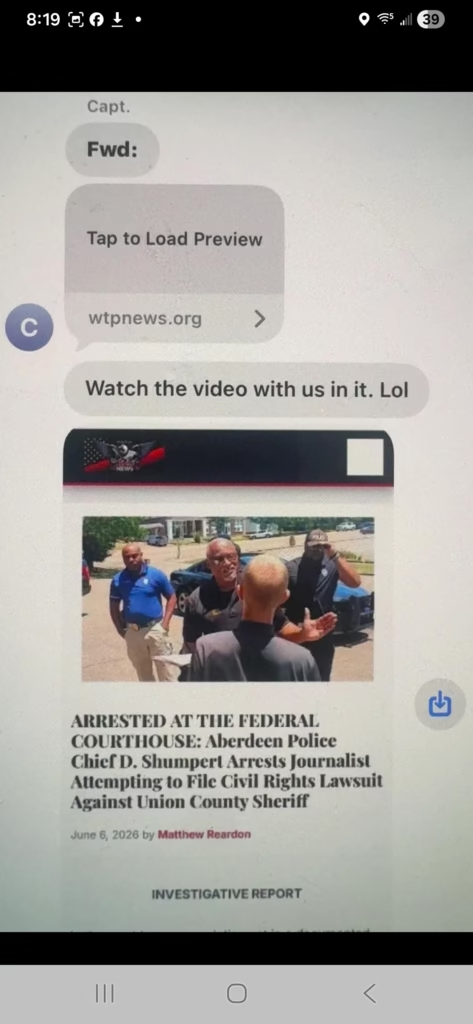
Less than 96 hours after Aberdeen Police Chief D. Shumpert arrested an independent journalist in the parking lot of a federal courthouse — physically preventing him from filing a civil rights lawsuit — a text message has surfaced showing an Aberdeen officer laughing about it. The text, allegedly sent by SRO Lee — known within the department as “Captain Lee” — was forwarded to fellow officers and contains a link to the WTP News investigative report covering the arrest, accompanied by five words that may haunt the Aberdeen Police Department in federal court: “Watch the video with us in it. Lol.” Lol. Laugh out loud. That’s what an Aberdeen police officer had to say about an arrest that violated the First, Fourth, and Fourteenth Amendments of the United States Constitution. That’s how seriously the Aberdeen Police Department takes the constitutional rights of the citizens it serves. The screenshot of the text was obtained by the Facebook page Monroe County Cop Watch, which published it along with a blistering commentary that has since generated dozens of comments and shares — igniting a public debate about police accountability, constitutional rights, and the culture inside the Aberdeen Police Department.The Text Message
The screenshot shows a message from a contact labeled “Capt.” — identified by Monroe County Cop Watch as SRO Lee, also known as Captain Lee within the department. The message contains:- A forwarded link to the WTP News article: “ARRESTED AT THE FEDERAL COURTHOUSE: Aberdeen Police Chief D. Shumpert Arrests Journalist Attempting to File Civil Rights Lawsuit Against Union County Sheriff“
- The article’s headline and thumbnail clearly visible in the preview
- The caption: “Watch the video with us in it. Lol”
Why This Text Matters — Legally
Captain Lee’s five-word text message is not just embarrassing. It is potentially devastating to every officer involved in the June 4 arrest — and here’s why.Qualified Immunity and “Clearly Established” Rights
Under federal civil rights law, officers accused of violating constitutional rights can assert qualified immunity — a legal shield that protects government officials from personal liability unless the right they violated was “clearly established” at the time of their conduct. But qualified immunity has limits. Courts examine not only whether the law was clear, but whether the officers acted reasonably and in good faith. An officer who mocks the arrest of a citizen exercising constitutional rights — who treats a federal courthouse arrest as a joke to share with colleagues — is not an officer acting in good faith. As Monroe County Cop Watch wrote in their post:“It boggles me how he could find humor in this considering he’s likely to be sued for violating the man’s rights. He could lose qualified immunity and have to foot the bill from his pockets.”That analysis is correct. When a § 1983 civil rights case goes before a federal judge, the question of whether officers understood the gravity of their actions is directly relevant. A text message saying “Lol” about an arrest that blocked a citizen from filing a federal lawsuit does not suggest an officer who misunderstood the law. It suggests an officer who didn’t care.
Evidence of Departmental Culture
Under Monell v. Department of Social Services, 436 U.S. 658 (1978), municipalities can be held liable for constitutional violations that result from an official policy, custom, or practice. A single text message is not a policy — but a text message circulated among officers, treating a retaliatory arrest as comedy, is evidence of a culture. It is evidence that the Aberdeen Police Department does not train its officers to respect constitutional rights. It is evidence that officers who participate in potentially unlawful arrests face no internal consequences — only congratulations from their peers. And it is evidence that the department’s leadership, starting with Chief Shumpert himself, has created an environment where violating a citizen’s rights is something to laugh about. Related: This pattern of law enforcement treating constitutional rights as optional extends beyond Aberdeen — a systemic issue across Mississippi departments.Consciousness of Guilt — Or Consciousness of Impunity?
In legal terms, a defendant’s post-incident behavior can be relevant to their state of mind at the time of the incident. An officer who, days after an arrest, forwards the evidence of that arrest to colleagues with “Lol” is demonstrating one of two things:- He knows what he did was wrong and doesn’t care, or
- He genuinely believes arresting a journalist at a federal courthouse is funny
Monroe County Cop Watch Weighs In
The Monroe County Cop Watch Facebook post did not mince words. The page — which monitors law enforcement conduct in Monroe County, Mississippi — published the text screenshot alongside a detailed commentary that sided firmly with the journalist’s constitutional rights:“It boggles me how he could find humor in this considering he’s likely to be sued for violating the man’s rights. He could lose qualified immunity and and have to foot the bill from his pockets. With the number of videos on the web I find it amazing that departments aren’t more careful in how they deal with these auditors.”The post acknowledged that the auditor was “rude to the people in the courthouse” — but drew a critical distinction that many law enforcement officers fail to understand:
“Was the auditor rude to the people in the courthouse by calling them motherfuckers and whatever else? Absolutely he was. But being rude isn’t against the law. You can’t harass and arrest people because feelings were hurt. It’s law enforcement not feelings enforcement.”“It’s law enforcement not feelings enforcement.” That single sentence captures the entire constitutional issue more effectively than a hundred pages of legal briefing. The First Amendment does not protect polite speech. It protects all speech — including speech that offends, provokes, and angers. As the Supreme Court held in Cohen v. California, 403 U.S. 15 (1971), the government cannot criminalize words simply because they are offensive. The Constitution protects the freedom of speech, not the comfort of the listener. Related: A Mississippi judge used profanity from the bench while presiding over a public profanity trial — underscoring the absurdity of prosecuting speech that the judiciary itself engages in.
The Comment Section: A Community Divided
The Monroe County Cop Watch post generated significant public engagement — over 30 reactions, nearly 60 comments, and more than a dozen shares. The comment section reveals a community grappling with the tension between authority and accountability: Those defending constitutional rights: One commenter, Todd Justice, wrote: “You don’t show ID in this country for anything unless you’ve committed a crime” and “I will be auditing there soon can’t wait.” Another pointed out: “ID is to identify who I am or more importantly, who I am not.” Those defending the officers: A commenter named Allen Smith wrote: “Comply and live. The lawbreakers are the one who hate law enforcers. All my life I have complied and I have never had an issue. You push my dog back into a corner and he will bite you.” Another argued: “If he cussed inside the courthouse he DID break the law.” Those who understand the legal framework: The page author, Tony Palma, responded to the ID debate with legal precision: “It is not unconstitutional to require ID to enter a federal courthouse however it is unconstitutional to force someone to leave public property without a violating a law.” A commenter named Chadwick Carlisle stated: “Well I know in any federal building you have to show 🪪 it’s been that way for years.” The debate itself is evidence of how deeply misunderstood constitutional rights remain — even among the public. The fact that trained law enforcement officers apparently share these misunderstandings is far more alarming.The Bigger Picture: A Pattern of Retaliation — Now With Receipts
The Captain Lee text does not exist in isolation. It is the latest data point in a documented, escalating campaign of retaliation against an independent journalist who has been reporting on government misconduct in northeast Mississippi:- April 20, 2026: Arrested for uttering a single profane word during public comment at the Union County Board of Supervisors — where Supervisor C.J. Bright has a documented history of confronting the journalist
- June 1, 2026: Arrested again for carrying a protest sign into public buildings — speech directly protected by Cohen v. California
- June 4, 2026: Arrested at the federal courthouse while attempting to file a civil rights lawsuit about the previous arrests
- June 7, 2026: An officer involved in the courthouse arrest forwards the evidence to colleagues as entertainment
A Message to Captain Lee
You thought it was funny. You forwarded the article to your colleagues so they could laugh along with you. “Watch the video with us in it. Lol.” Here’s what’s not funny: 42 U.S.C. § 1983. Qualified immunity analysis. Monell liability. Punitive damages. Discovery requests that will pull every text message, every email, and every group chat from every officer who was on that parking lot. You put it in writing. You hit send. And now a federal judge will read it. Lol.Related WTP News Coverage:
- ARRESTED AT THE FEDERAL COURTHOUSE: Aberdeen Police Chief D. Shumpert Arrests Journalist Attempting to File Civil Rights Lawsuit Against Union County Sheriff
- ARRESTED AGAIN: Union County Sheriff Charges Journalist for Carrying a Protest Sign Into Public Buildings
- THE DEEP DIVE: Inside the Shocking Boardroom Arrest & Civil Rights Violation in Union County
- “I Don’t Give a Rat’s Ass” — Mississippi Judge Uses Profanity From the Bench While Presiding Over a Public Profanity Trial
- “Enforce the Law, Not Feelings” — Marine Veteran Exposes Police Ignorance Outside Southaven City Hall
- Union County Supervisor C.J. Bright Confronts Journalist During First Amendment Activity
- Galveston Federal Lawsuit Enters Critical Phase
- Federal Courthouse Arrest: First Amendment Under Attack
Support Independent Journalism
We The People News is 100% independent and viewer-supported. No corporate sponsors. No agenda. Just the truth.
💰 CashApp: $1Aaudit
💰 Venmo: @badactors
💰 Chime: $badactors
💰 PayPal: paypal.biz/wtpnews
Share this investigation with anyone who believes in the First Amendment, government accountability, and the power of citizen journalism.
Related Coverage
- Federal Sentencing Set for August 7 in Lake Charles in Reardon Courthouse Case
- Father Releases Emotional Dedication Song to Children, Calling It a “Blueprint to the Truth”
- BREAKING: Marine Veteran Files Emergency Federal Motions After Galveston Seizes Second Vehicle — Asks Judge to Intervene Immediately
Legal & Records References
- Mississippi Public Records Act, Miss. Code Ann. § 25-61-1 et seq.
- Texas Public Information Act, Tex. Gov’t Code § 552
- U.S. Const. amend. I — First Amendment (Cornell LII)
Discover more from We The People News
Subscribe to get the latest posts sent to your email.
Leave a Reply