INVESTIGATIVE REPORT
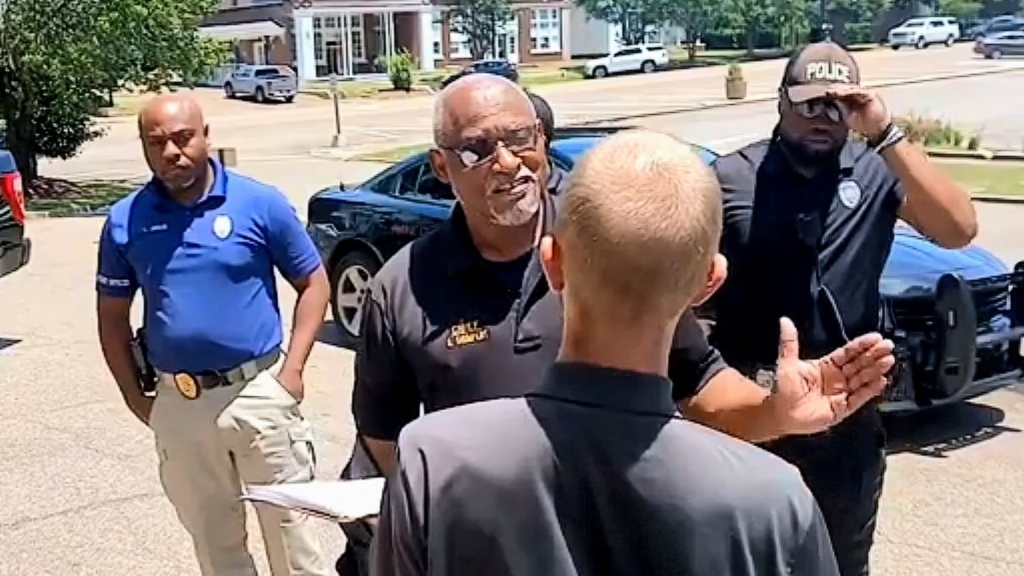
In the most brazen escalation yet in a documented campaign of retaliation against an independent journalist, Aberdeen Police Chief D. Shumpert arrested Matthew Reardon on June 4, 2026 — in the parking lot of the Thomas G. Abernethy Federal Building in Aberdeen, Mississippi — after Reardon was denied entry while attempting to file an emergency federal civil rights lawsuit against the very Union County officials who had already arrested him twice in six weeks for constitutionally protected speech.
Read that again: a journalist was arrested at the federal courthouse while trying to file a lawsuit about being arrested.
His car was searched. His car was towed. And the evidence suggests a clear coordination between federal officers and local city police — a coordination designed to funnel the prosecution into municipal court, keeping it away from the federal judiciary that Reardon was walking through the front door to petition.
The constitutional implications are staggering. The right to petition the government for redress of grievances is among the most fundamental protections in the American legal system. And on June 4, 2026, that right was physically denied to a citizen standing in the lobby of a federal courthouse with a stack of legal filings in his hands.
Related: This is not the first time city police have been called to a federal courthouse to confront a journalist exercising constitutional rights — and it likely won’t be the last.
🎥 Watch the Videos
Part 1 — What Led Up to the Arrest:
Part 2 — The Arrest at the Federal Courthouse:
What Reardon Was Filing — And Why It Matters
Reardon did not arrive at the Thomas G. Abernethy Federal Building empty-handed. He came prepared to file a comprehensive federal civil rights lawsuit under 42 U.S.C. § 1983 — six documents totaling over 100 pages — against Union County Sheriff Jimmy Edwards, Board of Supervisors President CJ Bright, Investigator Adam Fitz, Union County itself, and the Commissioner of the Mississippi Department of Corrections.
The filings included:
- A Federal Complaint for Violations of Civil Rights Under 42 U.S.C. § 1983 — alleging a coordinated, escalating campaign of First Amendment retaliation including two unlawful arrests, a phantom MDOC hold, warrantless seizure of evidence, and explicit threats of continued arrests
- An Emergency Motion for Temporary Restraining Order and Preliminary Injunction — asking the federal court under Federal Rule of Civil Procedure 65 to immediately restrain Union County officials from arresting, detaining, or prosecuting Reardon for constitutionally protected speech
- A Memorandum of Law — a comprehensive legal brief citing Cohen v. California, United States v. Grace, Reed v. Town of Gilbert, and over a dozen additional Supreme Court and federal cases
- A Declaration of Matthew Reardon — a sworn statement under penalty of perjury detailing every incident from April 15 through June 1, 2026
- A Motion for ECF Filing Privileges — requesting electronic filing access because Reardon is homeless, living out of his vehicle, and traveling between multiple states to attend court proceedings
- An Application to Proceed In Forma Pauperis — demonstrating that Reardon is indigent and unable to pay filing fees
These were not the ramblings of a disgruntled citizen. These were meticulously prepared legal documents — filed in the correct division of the U.S. District Court for the Northern District of Mississippi — that laid out a devastating constitutional case against officials who had been violating Reardon’s rights for weeks. The complaint alone identified nine defendants, cited controlling Supreme Court precedent, and requested declaratory relief, injunctive relief, compensatory damages, and punitive damages.
And someone made sure he never got to file them.
June 4, 2026: “You Got to Have a Valid Photo ID to Enter”
On the afternoon of June 4, 2026, Matthew Reardon drove to the Thomas G. Abernethy Federal Building at 301 West Commerce Street in Aberdeen, Mississippi. The building houses the U.S. District Court for the Northern District of Mississippi — Aberdeen Division — along with the U.S. Marshals Service and the U.S. Postal Service. Aberdeen Division covers 13 counties in northeast Mississippi, including Union County — the county where Reardon had been arrested twice for protected speech.
Reardon’s purpose was straightforward: walk into the Clerk’s Office, file his emergency lawsuit, and seek the protection of the federal judiciary from a county sheriff who had explicitly promised — on camera — to “keep arresting” him.
What happened next was captured on video.
Upon entering the building, Reardon was met at security. He stated his purpose clearly.
Security: “Federal courthouse or post office?”
Reardon: “Federal courthouse.”
Security: “All right, you’re in the right place. Sir, what can we do for you?”
Reardon: “I got to go up to the clerk’s office.”
Security: “Do you have some ID, sir?”
Reardon: “No.”
Security: “You got to have a valid photo ID to enter. You can’t enter.”
Reardon immediately objected:
“That’s incorrect. That’s absolutely incorrect. That’s a Fourth Amendment violation. I’m here to file a federal civil rights lawsuit. Y’all can’t stop me from doing it. I need to go up to the clerk’s office. This is an emergency situation and I’m not showing you ID to file a lawsuit.”
Security’s response was to call for a supervisor — identified on video as “Larry.” But the conversation only escalated. Reardon cited his experience entering federal courthouses across the country:
“This is some of the most outrageous stuff I’ve ever seen. I’ve been in plenty of courthouses. I am a civil rights litigant. I’m here to file a lawsuit. It’s an emergency matter. I’m not showing these guys ID to go up there and go file a lawsuit. This is the first courthouse I’ve ever been into [that requires this]. I will file a lawsuit over that sign right there. That is illegal. That is unconstitutional. You cannot require ID to go up to the clerk’s office.”
When told he could not enter without identification, Reardon asked to have the Clerk come to him:
“Call the clerk down here then. The clerk can take my lawsuit down here. She can take my lawsuit down here then if y’all going to be difficult.”
The response: a man identified as “Mr. Lipshutz” would arrive in approximately 20 minutes. Reardon was also told he could not record inside the facility “by order of the US Marshal” — a detail that takes on new significance given previously documented ex parte communications between the U.S. Marshals Service and federal courts.
Twenty minutes to wait. For a man who came to file an emergency civil rights lawsuit. A man who had driven to the courthouse because a sheriff had promised on camera to “keep arresting” him. And instead of the Clerk’s Office, he got a lobby, a lecture, and a wait.
There is no federal law requiring citizens to present identification to enter a public federal courthouse for the purpose of filing legal documents. While federal buildings may employ security screening — metal detectors, bag checks — the requirement to produce government-issued identification as a precondition for entering a courthouse to petition the court raises serious constitutional concerns under both the First and Fourth Amendments. This is particularly true when applied to a pro se litigant who is attempting to exercise his fundamental right of access to the courts and who has stated his purpose clearly.
The Arrest: “If I Don’t Give My ID, Will I Go to Jail?” — “Probably.”
What followed was not a security screening. It was an arrest orchestrated by city police on federal property.
Outside the building, officers attempted to search Reardon and inspect his vehicle’s license plate. The video captures officers physically trying to get around Reardon to see his tag:
“No, sir. That’s an illegal search and seizure. I do not consent to search and seizures. This guy was doing everything he could to get around to my tag, get around my arm, see what my tag was. They’re blocking me from going into the courthouse. I have a constitutional right to enter to file my lawsuit.”
Reardon removed his license plate to prevent them from running it without cause: “I’m going to take it off. How about that?”
When Aberdeen city police arrived — at a federal building — Reardon asked what was happening:
Reardon: “What’s going on is they’re violating my constitutional rights.”
Chief Shumpert: “How are they violating your rights?”
Reardon: “I have a right to access the court. I am filing an emergency civil rights lawsuit. They’re telling me that I cannot go in there.”
Chief Shumpert: “You don’t have ID.”
Reardon: “Why do I need to show you ID? That’s a matter between me and the clerk. I’ve got a lawsuit to file.”
Chief Shumpert: “They have to know who y’all are.”
Reardon: “I’ve been all around the country. I’ve been into many federal courthouses. This is not my first rodeo.”
Chief Shumpert’s response was chilling in its simplicity:
“You have to go file it somewhere else. You don’t want to show them ID.”
File it somewhere else. The Aberdeen Division is the correct venue for cases arising in Union County, Mississippi. There is no “somewhere else.” And even if there were, a citizen should not have to shop for a courthouse willing to accept his lawsuit without demanding his papers first.
When told to leave, Reardon asked a critical question: “If it’s under threat of arrest, I’ll leave so I can go file my lawsuit. Am I under threat of arrest?”
Chief Shumpert’s response: “I’m just asking you to leave.” Then: “If you’re not trying to go to jail, you need to leave.”
Reardon began to comply: “All right. That was a threat of arrest. Wow. They blocked me from filing a federal civil rights lawsuit.”
But it wasn’t over. Aberdeen Police Chief D. Shumpert himself arrived and escalated the confrontation. He demanded Reardon’s identification, claiming Reardon had “caused a disturbance” — despite having conducted no investigation:
Reardon: “I didn’t cause a disturbance.”
Chief Shumpert: “According to them, you did.”
Reardon: “According to them — have you done any kind of investigation?”
Chief Shumpert: “Give me your name.”
Reardon: “I’m telling you, I’m not going to give it unless there’s reasonable articulable suspicion.”
Chief Shumpert: “It is, because you caused a disturbance in there. Give me your name.”
Reardon: “Can you investigate it first? They have cameras in there.”
Chief Shumpert: “Let me see your ID, please, sir. Your ID.”
Reardon: “Can I see your captain? Can I see your supervisor?”
Chief Shumpert: “I’m the police chief.”
The exchange that followed should disturb every American who believes in constitutional policing:
Reardon: “May I see your ID, please?”
Chief Shumpert: “May I see your ID?”
Reardon: “If it’s under threat of arrest, I’ll provide. Is it under threat of arrest? If I don’t give my ID, will I go to jail?”
Chief Shumpert: “Probably.”
Reardon: “No, I need a definite. If I don’t give my ID, will I go to jail?”
Under duress, Reardon verbally identified himself: “It’s Matthew Reardon. R-E-A-R-D-O-N.”
But it still wasn’t enough. Despite providing his name, date of birth, and spelling his name multiple times, Chief Shumpert escalated the confrontation further. And then came the arrest:
“Turn around. Put your hands behind your back. Put your phone down.”
Reardon’s response, captured on video: “I had a lawsuit to file. You know that.”
Chief Shumpert’s reply is perhaps the most revealing statement in the entire video: “And all you had to do was identify yourself. You were welcome to go up there and file whatever paperwork you needed to file. It’s that simple.”
It’s that simple — except that it isn’t. Compelling identification as a precondition for accessing a federal court is not “simple.” It is a constitutional question that implicates the First, Fourth, and Fourteenth Amendments. And resolving that question by arresting the citizen who raised it is not law enforcement — it is retaliation. This pattern of arrests at federal courthouses for constitutionally protected activity has been documented before.
The Jurisdiction Question: What Was Chief Shumpert Doing on Federal Property?
This is where the story turns from an outrageous First Amendment violation into something potentially far more troubling: a coordinated effort to prevent a citizen from accessing the federal courts.
The Thomas G. Abernethy Federal Building is federal property. It is owned and maintained by the General Services Administration (GSA). It houses a United States District Court. Law enforcement within the building falls under the jurisdiction of the U.S. Marshals Service and, for building security, the Federal Protective Service.
So why was Chief D. Shumpert — a municipal officer — the one making the arrest?
The video makes clear that building security called the Aberdeen city police. Reardon was told that recording was prohibited “by order of the US Marshal” — confirming federal law enforcement awareness of the situation. Yet when it came time to make an arrest, it was Chief Shumpert who showed up, conducted no independent investigation (“According to them, you did”), demanded identification, and ultimately placed Reardon in handcuffs.
The legal framework governing jurisdiction on federal property is well-established and depends on the type of jurisdiction the federal government holds over the land:
- Exclusive federal jurisdiction: Only federal law enforcement can enforce laws. State and local police have no authority unless formally invited for a specific purpose.
- Concurrent jurisdiction: Both federal and state/local authorities can enforce their respective laws. However, the decision of which court handles prosecution is significant.
- Proprietary jurisdiction: The federal government owns the land but state and local law enforcement retain primary responsibility.
Regardless of which jurisdictional framework applies to the Abernethy Building, the routing of this arrest tells a damning story. If federal officers were present — and at a federal courthouse housing the U.S. Marshals Service, they were — why was a city police chief making the arrest? And why was the prosecution funneled to municipal court rather than federal court?
The answer is as simple as it is alarming: because federal court is exactly where Reardon was trying to go.
If Reardon had been charged under federal law and brought before a federal magistrate, he would have been standing in the very court where his civil rights complaint was about to be filed — in front of a federal judge who would have immediately seen the pattern. By routing the arrest through Chief Shumpert and the Aberdeen city police and into municipal court, the entire matter was kept away from the federal judiciary.
Whether this was deliberate coordination or bureaucratic convenience, the effect was the same: a citizen seeking the protection of the federal courts was arrested at those courts, and his case was sent as far from federal oversight as legally possible. This mirrors a broader pattern that WTP News has documented, including how the U.S. Marshals Service has been exposed through FOIA records for its role in silencing press activity at federal buildings.
The Right of Access to the Courts: One of the Oldest Rights in American Law
The right of access to the courts is not a peripheral constitutional protection. It is among the oldest and most fundamental rights recognized in American law — and its violation carries some of the most serious legal consequences.
In Bounds v. Smith, 430 U.S. 817 (1977), the Supreme Court held that “the fundamental constitutional right of access to the courts requires prison authorities to assist inmates in the preparation and filing of meaningful legal papers by providing prisoners with adequate law libraries or adequate assistance from persons trained in the law.” If even prisoners cannot be denied access to the courts, how can a free citizen be physically prevented from walking into a federal courthouse to file a lawsuit?
In Christopher v. Harbury, 536 U.S. 403 (2002), the Supreme Court reaffirmed that the right of access to courts is “an aspect of the First Amendment right to petition the Government for redress of grievances.” The Petition Clause of the First Amendment does not merely protect the right to speak — it protects the right to seek justice through the courts.
In Bill Johnson’s Restaurants, Inc. v. NLRB, 461 U.S. 731 (1983), the Court stated that “the right of access to the courts is an aspect of the First Amendment right to petition the Government for redress of grievances” and warned that government actions that chill this right are constitutionally suspect.
What happened on June 4 was not a chill. It was a freeze. A citizen walked into a federal courthouse with legal documents ready to file, and he was arrested before he could reach the Clerk’s window.
The Car Search and Tow: “What Are You Doing With My Car?”
The arrest itself was not the only government action that day. As Reardon was placed in the police vehicle, his own video captured his reaction: “What are you doing with my car?”
Reardon’s vehicle — which, as stated in his Motion for ECF Filing Privileges, doubles as his home — was searched and towed from the federal courthouse parking lot. His phone was seized and placed in the car rather than returned to him: “I need my phone.” — “It’ll be in your car.” — “Can’t go in my car.”
For a homeless journalist living out of his car, the seizure of his vehicle is not merely an inconvenience. It is the seizure of his home, his office, his transportation, and his means of survival. It is also the seizure of whatever evidence, legal documents, recording equipment, and personal property he had inside.
The Fourth Amendment requires either a warrant supported by probable cause or a recognized exception to the warrant requirement before law enforcement can search a vehicle. What probable cause existed to search the car of a man whose only “crime” was attempting to file a lawsuit? This is not the first time Reardon has had evidence seized during an arrest — the June 1 arrest also involved warrantless seizure of his phone, which contained evidence of the officers’ own misconduct.
A Timeline of Escalation
The June 4 arrest does not exist in isolation. It is the latest — and most extreme — act in a documented, escalating pattern of government retaliation against a journalist who has been publicly criticizing Union County officials:
| Date | Event |
|---|---|
| April 15, 2026 | Board of Supervisors President CJ Bright personally confronts Reardon on a public sidewalk during a lawful First Amendment audit — then admits on camera he cannot legally stop him. |
| April 20, 2026 | The Board issues a preemptive “gag rule” banning profanity. Reardon is arrested for uttering a single profane word during public comment — before finishing his sentence. A phantom MDOC hold — reserved for violent offenders — is placed on him with no legal basis. |
| April 21, 2026 | A judge immediately releases Reardon after hearing constitutional arguments and clearing the phantom holds. |
| May 5, 2026 | Reardon appears in Union County Justice Court pro se. The presiding judge uses profanity from the bench — “I don’t give a rat’s ass about that” — during a hearing about profanity charges. Reardon files nine motions citing 32 Supreme Court cases. |
| June 1, 2026 | Reardon is arrested again for carrying a “FUCK CITY HALL” sign into public buildings — speech directly protected by Cohen v. California. Sheriff Edwards states: “And I’m gonna keep arresting you.” His phone is seized without a warrant. |
| June 4, 2026 | Reardon is arrested by Chief Shumpert at the federal courthouse in Aberdeen while attempting to file his civil rights lawsuit against the Union County Sheriff. His car is searched and towed. The prosecution is routed to municipal court. |
Three arrests in 45 days. Each one for constitutionally protected activity. Each one escalating in severity. And the final one designed — whether by intent or effect — to prevent the journalist from seeking the protection of the federal judiciary. As WTP News has previously reported, profanity is constitutionally protected speech under decades of Supreme Court precedent — making each of these arrests a clear act of retaliation for protected activity.
The Lawsuit They Didn’t Want Filed
The federal complaint Reardon was carrying makes for devastating reading — and it may explain why someone didn’t want it filed.
The complaint names Sheriff Jimmy Edwards in both his individual and official capacity. It names CJ Bright individually. It names Investigator Adam Fitz individually. It names Union County itself. And critically, it names the Commissioner of the Mississippi Department of Corrections in his official capacity and three John Doe MDOC agents — the individuals behind the phantom corrections hold that was used to extend Reardon’s detention after the April 20 arrest.
The complaint alleges:
- First Amendment retaliation — Two arrests targeting constitutionally protected speech, with explicit threats of continued arrests
- Fourth Amendment violations — Warrantless seizure of Reardon’s cell phone containing evidence of the officers’ own misconduct
- Fourteenth Amendment due process violations — Prosecution under unconstitutionally vague statutes, including one the presiding judge couldn’t follow without using profanity himself
- Conspiracy to deprive civil rights — Coordinated action between Union County officials and MDOC to use a phantom corrections hold as punishment
- Excessive force — Aggressive handcuffing and arm-wrenching on both arrest occasions despite knowledge of Reardon’s pre-existing shoulder injury requiring three hospitalizations
- Municipal liability under Monell v. Department of Social Services — Alleging Union County has a policy, practice, or custom of retaliating against critics
The TRO motion attached to the complaint asked for immediate federal court intervention: an emergency order restraining the sheriff and all Union County officials from arresting Reardon for protected speech. The legal standard for such relief is high — but the facts were overwhelming. As Reardon’s memorandum of law states:
“This is the rare case where emergency relief is not just warranted — it is demanded by the facts. A government actor has announced, on the record, that he will continue violating a citizen’s clearly established constitutional rights.”
That emergency motion never reached a federal judge. The man carrying it was arrested in the parking lot.
Reardon is no stranger to filing federal civil rights lawsuits. His ongoing federal case in Galveston has already survived motions to dismiss, and his track record shows charges being refused by prosecutors who reviewed the evidence.
The Questions That Demand Answers
- Who called Chief Shumpert? City police do not routinely patrol the interior of federal courthouses. The video confirms building security called city police. Someone inside the building — whether a federal marshal, a building security officer, or another official — made that call. Who authorized it, and why?
- Were the U.S. Marshals involved? The U.S. Marshals Service has office space in the Abernethy Building. Reardon was told recording was prohibited “by order of the US Marshal.” Did marshals participate in the decision to call city police or to deny Reardon entry? Were they aware of any prior alerts about Reardon? FOIA records have previously exposed troubling communications between the Marshals Service and the courts.
- Who is “Mr. Lipshutz”? When Reardon asked for the Clerk to come down, he was told “Mr. Lipshutz will be here in about 20 minutes.” Who is this individual, what role does he play, and why was a 20-minute wait imposed on a man filing an emergency motion?
- Why was the prosecution routed to municipal court? If the arrest occurred on federal property, why wasn’t the matter handled in the federal court that occupies that very building? Whose decision was it to route the prosecution to Aberdeen municipal court?
- What was the legal basis for the car search? What probable cause existed to search the vehicle of a man who arrived at a courthouse with legal documents? Was a warrant obtained? If not, which exception to the warrant requirement was invoked?
- What was the legal basis for the tow? Reardon’s vehicle was legally parked in a public parking area. On what authority was it towed?
- Were Union County officials involved? Given the documented pattern of retaliation — and the sheriff’s on-camera promise to “keep arresting” Reardon — did anyone from Union County contact federal officials or Aberdeen police to alert them about Reardon’s arrival?
- What “disturbance” did Chief Shumpert investigate? Chief Shumpert claimed “reasonable articulable suspicion” based on a “disturbance call” — but admitted on video he relied entirely on the word of building security: “According to them, you did.” Reardon asked him to review the security cameras. Did he? Has anyone reviewed that footage?
- Does Chief Shumpert know that he may have helped obstruct a federal lawsuit? Arresting a citizen who is actively attempting to file a civil rights complaint in federal court is not a routine police action. It is an act that implicates the fundamental right of access to the courts — and the officers involved may face personal liability under 42 U.S.C. § 1983.
The Constitutional Stakes
If a citizen can be arrested at a federal courthouse while trying to file a lawsuit, then the right of access to the courts is meaningless. Every disgruntled sheriff, every corrupt official, every government actor facing accountability can simply arrange to have the plaintiff arrested before the complaint reaches the Clerk’s window.
This is not hyperbole. This is what happened on June 4, 2026, in Aberdeen, Mississippi.
The First Amendment protects the right to petition the government for redress of grievances. The Fourteenth Amendment guarantees due process. The right of access to the courts has been recognized by the Supreme Court as fundamental to both. And all of these rights were violated when Matthew Reardon was arrested in the parking lot, searched, and towed from a federal courthouse while carrying the very documents that would have brought a federal judge into the case.
The irony is crushing: the lawsuit Reardon was trying to file warned the court that the sheriff had explicitly promised to keep arresting him. The emergency TRO motion asked for immediate protection. And before a federal judge could read a single word, the system proved Reardon’s entire case for him.
Chief Shumpert’s own words — captured on Reardon’s camera — may prove to be the most damning evidence of all. When asked what would happen if Reardon didn’t show ID, the Police Chief of Aberdeen, Mississippi responded with a single word:
“Probably.”
Probably. Not a citation to a statute. Not a reference to probable cause. Not an articulable suspicion of a crime. Just: probably.
That word — and everything that followed it — will echo through the federal courts of Mississippi for a long time to come.
Related WTP News Coverage
- ARRESTED AGAIN: Union County Sheriff Charges Journalist for Carrying a Protest Sign Into Public Buildings
- THE DEEP DIVE: Inside the Shocking Boardroom Arrest & Civil Rights Violation in Union County
- “I Don’t Give a Rat’s Ass” — Mississippi Judge Uses Profanity From the Bench
- “Enforce the Law, Not Feelings” — Marine Veteran Exposes Mississippi’s Profanity Statute
- City Cops Called to Federal Courthouse Over Lawful Filming — First Amendment Audit
- CJ Bright Confronts Journalist During First Amendment Activity in New Albany
- Federal Courthouse Arrest: First Amendment Under Attack
- FOIA Records Expose Ex Parte Communications Between U.S. Marshals and Federal Judges
- U.S. Marshals Exposed: FOIA Reveals #OperationSilenceThePress
- Galveston Federal Lawsuit Enters Critical Phase
- VINDICATED: DA Refuses All Charges Against Journalist
- Profanity Is NOT a Crime — It’s Protected Speech Under the First Amendment
Support Independent Journalism
We The People News is 100% independent and viewer-supported. No corporate sponsors. No agenda. Just the truth.
💰 CashApp: $1Aaudit
💰 Venmo: @badactors
💰 Chime: $badactors
💰 PayPal: paypal.biz/wtpnews
Share this investigation with anyone who believes in the First Amendment, government accountability, and the power of citizen journalism.
Discover more from We The People News
Subscribe to get the latest posts sent to your email.
Leave a Reply