A Journalist Walked Into New Orleans City Hall. He Left in an Ambulance — Then They Arrested Him.
An investigation by We The People News into the assault, cover-up, and retaliatory prosecution of independent journalist Matthew Reardon at New Orleans City Hall — supported by official documents, recorded phone calls, and the city’s own records.
I. The Assault: November 12, 2025
At approximately 9:23 a.m. on November 12, 2025, Matthew Oliver Reardon — a United States Marine Corps veteran, independent journalist, and First Amendment auditor — walked into New Orleans City Hall at 1300 Perdido Street during regular business hours. He was there to do what journalists do: document government operations. He was actively livestreaming.
He never made it past the security checkpoint.
Allied Universal security guard Jerome Ard confronted Reardon at the entrance, demanding he surrender a pack of cigarettes, a lighter, and a vape device from his pocket — items that no written city policy, ordinance, or posted rule prohibits visitors from carrying inside City Hall. When Reardon questioned the non-existent policy, Ard escalated.
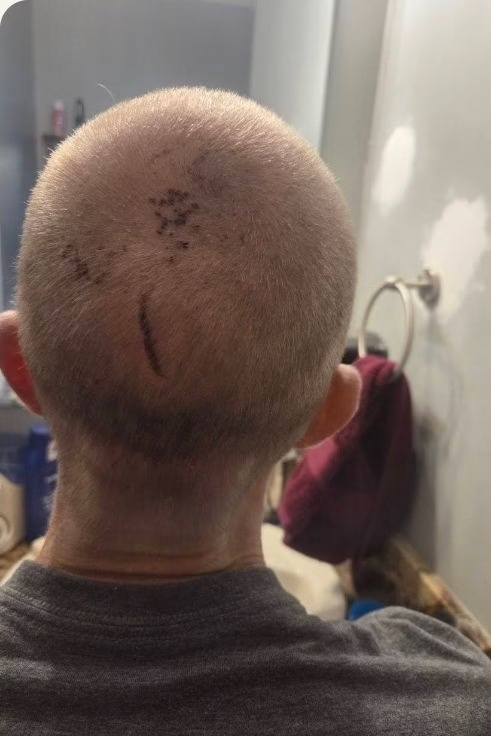
What happened next was captured on Reardon’s livestream: Ard struck Reardon in the back of the head with a metal flashlight — a dangerous weapon under Louisiana law — splitting his head open and sending him to the ground. Reardon collapsed on the sidewalk outside City Hall, bleeding profusely from a serious head laceration.
But Ard wasn’t done. He picked up Reardon’s phone — still livestreaming — and hurled it to the ground, shattering the device and destroying Reardon’s primary journalistic equipment along with a gimbal. An apparent attempt to destroy evidence of the crime he had just committed.
What Ard didn’t know: the livestream kept recording. The entire assault was captured and preserved.
For approximately thirty minutes, Matthew Reardon lay bleeding on the sidewalk outside New Orleans City Hall while nobody called 911.
City employees walked past. Allied Universal guards — including witnesses Wilfred Vidal and Willie Savage, Ard’s own coworkers — did nothing to summon medical help. According to the formal notice of intent filed in the case, this delay was deliberate: the guards present “had a shared interest in minimizing the severity of the assault.”
Reardon was forced to crawl into the street to attract the attention of passing motorists before someone finally called 911. He was transported by EMS to Tulane Medical Center for emergency treatment of head trauma.
II. The Cover-Up Begins: NOPD Makes the Victim the Criminal
When NOPD Officers Junious Grady and Victor Paz arrived on scene, they found Reardon face-down on the sidewalk in a pool of blood. What they did next would set in motion a months-long institutional cover-up.
Instead of investigating what was plainly an aggravated battery, the officers:
- Took statements exclusively from three Allied Universal employees — the attacker’s own coworkers — and never once interviewed Reardon, the obvious victim
- Reviewed RTCC (Real-Time Crime Center) camera footage but admitted in their own sworn affidavit that they “were unable to view the physical altercation” because it occurred outside the camera’s view
- Despite having no video evidence of the altercation and relying solely on biased witness statements from the attacker’s colleagues, designated Matthew Reardon — the man bleeding from his head on the sidewalk — as the “aggressor”
Officer Grady then executed an Affidavit for Arrest Warrant that was, by any objective standard, fatally defective. The affidavit:
- Omitted Reardon’s report of being struck with a metal flashlight
- Characterized a hospital-transport-level head injury as merely a “small laceration”
- Relied exclusively on the statements of interested witnesses — the attacker’s own coworkers
- Identified the victim as the perpetrator
NOPD Supervisor Alfred Harris (ID# 16511) signed off on it. A warrant was issued, entered into the NCIC national database, and would hang over Reardon’s head for months.
The charge? Simple battery — against the man who was hospitalized with a head wound.
III. “Nobody’s Home”: The November 14 Phone Calls
Two days after the assault, on November 14, 2025, Reardon began making phone calls. He called every office he could think of: the NOPD switchboard, every precinct, the Public Integrity Bureau, the Mayor’s Office, and the City Attorney’s Office. Every call was recorded. Every call tells the same story: a city government that either didn’t know, didn’t care, or actively refused to help a crime victim.
Call to NOPD Non-Emergency Line
Reardon asked to speak with someone about the New Orleans Police Department’s Victim Witness Assistance Program — a program mandated by Louisiana state law (La. R.S. 46:1841 et seq.) and prominently featured on NOPD’s own website.
NOPD Operator: “Oh, what a victim — what is that?”
Reardon: “The Victim Witness Assistance Program. You don’t know about that?”
Operator: “No, this is a call center. We’re not officers here… I tried to look it up in our contact list, and we don’t have any phone number for that.”
The operator — the first point of contact for the public reaching out to NOPD — had never heard of the program. She suggested Reardon try calling individual districts and “change the last numbers.”
Calling All Precincts
Reardon dialed precinct after precinct. The result was the same across the board: nobody answered. Nobody home. As Reardon documented it: “CALLING ALL PRECINCTS — nobody’s home.”
The 311 Switchboard Run-Around
After being transferred approximately ten times, Reardon ended up at 311 — the city’s general information line. The operator there was at least honest about the problem:
311 Operator: “There’s no number. I know. And see, that’s the problem… the big problem with government is that they love to codify things in policy just to say that they had it, and then policy without implementation is just nothing.”
The operator eventually suggested Reardon try the Public Integrity Bureau at 504-658-6800.
Call to NOPD Public Integrity Bureau
Reardon reached a woman identified as Ms. Parks. When he asked about the Victim Witness Assistance Program, she transferred him — to a domestic violence detective’s voicemail.
He called back. Ms. Parks admitted she didn’t know anything about the program:
Reardon: “I’ve called around and nobody seems to know anything about this Victim Witness Assistance Program. And it’s a state law and it’s actually codified on y’all’s website and not one person seems to know anything about it. Now, how can an officer ever faithfully uphold their duties, how can they protect a victim’s rights if they don’t even know about the Victim Witness Assistance Program?”
Ms. Parks: “I’m sure that’s probably a special division.”
When Reardon finally detailed the assault and the officers’ failures, Parks said she would pass the complaint to an investigator. She took his name: Matthew Reardon, R-E-A-R-D-O-N.
Call to the Mayor’s Office
An official identified as Officer Christian took Reardon’s call at the Mayor’s Office. When Reardon described being violently assaulted at City Hall, Christian’s first instinct was to distance the city from responsibility:
Officer Christian: “They are not a part of the city. That’s just a contract that the city has with that security company.”
Reardon pushed back:
Reardon: “Ultimately, the city is responsible. The city is 100% liable for what they do in the course of their business in City Hall.”
Christian suggested Reardon call back on Monday because “a lot of people are gone for the day” — it was a Friday afternoon.
Call to the City Attorney’s Office
Reardon reached Tana Scoby at the City Attorney’s Office. The conversation was remarkable for its revelation: the City Attorney’s Office — located on the 5th floor of the same building where the assault occurred — claimed to have no knowledge that a journalist had been violently assaulted in their own lobby two days earlier.
Reardon: “I need to confirm — does the City Attorney’s office acknowledge that a member of City Hall security physically struck me?”
Scoby: “I don’t have any knowledge of that. We don’t have knowledge of that.”
Reardon: “Y’all don’t have any knowledge of that? How would we know that?”
Scoby: “Well, it was a pretty big ordeal…”
Scoby: “I’m not even aware a situation happened Tuesday. We’re on the fifth floor and we’re in meetings all day and hearings all day.”
Scoby did provide her email — [email protected] — for Reardon to send his notice of claim. She acknowledged that if litigation arose from the incident, it would indeed be the City Attorney’s business. But she maintained the office was completely unaware of the assault.
A violent assault in the main lobby of City Hall. A man left bleeding on the sidewalk for half an hour. EMS and police responding. And two days later, the City Attorney’s Office on the fifth floor of the same building claims total ignorance.
IV. The Stonewall: Public Records and the December 10 Call
Following the assault, Reardon filed Public Records Request No. 25-21253 under the Louisiana Public Records Act (La. R.S. 44:1 et seq.), seeking:
- All RTCC camera footage covering front entrance sidewalks, public lobby, and security screening area
- All City Hall interior security camera footage for the period of 9:00–10:30 a.m. on November 12
- All 911 call logs, CAD entries, and dispatch traffic
- All incident reports, written statements, and security logs
- All NOPD body-worn camera footage from responding officers
- All radio communications referencing the incident
Louisiana law requires prompt production. What Reardon got instead were “generic messages” — the same boilerplate responses, over and over, for weeks.
On December 10, 2025 — nearly a month after the assault — Reardon called the City Attorney’s Office again. This time he reached Tommy Milner, who identified himself as having been “an ACLU lawyer… a First Amendment lawyer… a public records lawyer.”
Milner’s response to a crime victim demanding evidence of his own assault was to cite bureaucratic backlog:
Milner: “As of today, since January 1st, we’ve had 21,250 different public records requests of the City of New Orleans… And yours is actually sort of six requests rolled into one.”
Reardon: “I was bleeding out on the sidewalk. Are you kidding me?”
Milner: “What we do is we try to fulfill all the public records requests in the interest of transparency, you know, as quickly as we can.”
When Reardon pressed, pointing out that the delay was a violation of Louisiana law, Milner fell back on the familiar refrain:
Milner: “I’m just doing the best I can. That’s all I can tell you, sir.”
Reardon gave them a deadline: 12 o’clock the next day, or he’d file suit. The city ultimately invoked “anticipated criminal litigation” as its excuse to withhold the surveillance footage — using the very criminal case they had manufactured against the victim as a shield to suppress the evidence that would exonerate him.
Read that again: the city arrested the victim, then used his arrest as the legal justification to hide the evidence of his victimization.
V. The Retaliatory Arrest: January 24, 2026
On January 24, 2026, during a severe winter storm in Lafayette, Louisiana, Matthew Reardon sought shelter at an emergency warming center. He was a veteran. He needed warmth.
The defective NCIC warrant — the one based on the one-sided affidavit that named the bleeding victim as the aggressor — was still active. It triggered his arrest at the warming shelter.
Reardon was jailed, extradited to Orleans Parish, and booked:
- Arrest No.: 12485172
- Folder No.: 2548390
- Charge: Simple Battery (14:35) — one count, for an incident on November 12, 2025
The Pretrial Services Assessment (PSA) generated on January 29, 2026, by the Criminal District Court for the Parish of Orleans tells its own story. Reardon scored a Risk Level 1 — the lowest possible risk category. The assessment recommended “Unsupervised Release.” He had no pending charges, no prior felonies, no prior violent convictions, no prior failures to appear. His only criminal history: a 2014 misdemeanor DUI in Georgia, over a decade old.
This was not a dangerous criminal. This was a journalist and Marine veteran who had been assaulted at City Hall and was now being prosecuted for it.
His vehicle keys disappeared while in law enforcement custody.
VI. The DA Says It All: “REFUSED — LAW ENFORCEMENT ISSUE”
On April 16, 2026, the Orleans Parish District Attorney’s Office screened the case — DA Case No. M-625048 — and dropped the hammer.
All charges were refused under Disposition Code 433: “REFUSED — LAW ENFORCEMENT ISSUE.”
This is not a technicality. This is not a case that fell apart on a procedural error. Code 433 is an official prosecutorial finding that the police work itself was fatally defective. The DA’s Office looked at what NOPD presented and said: the problem isn’t the defendant — the problem is the cops.
In a city where the DA’s office routinely accepts NOPD cases, this refusal is a damning institutional rebuke. The very machinery of justice that was supposed to protect Matthew Reardon had been weaponized against him — and when an independent authority finally examined the evidence, the whole thing collapsed.
VII. The Investigation That Wasn’t
In the months following the assault, the City of New Orleans assigned Sergeant Davis of the NOPD Public Integrity Bureau to the case. But Davis wasn’t investigating the felony assault on Reardon. He was assigned solely to examine whether the responding officers committed misconduct.
No one at NOPD investigated the actual crime — the aggravated battery committed by Jerome Ard. No one arrested Ard. No one charged Ard. The man who split a journalist’s head open with a metal flashlight in the lobby of City Hall walked away, and the city’s investigative apparatus focused exclusively on whether the paperwork was done properly.
When Reardon asked about the Victim Witness Assistance Program — a protection mechanism for crime victims mandated by Louisiana law and posted on NOPD’s own website — not a single person across the entire New Orleans Police Department could identify it or explain how it worked.
VIII. The $2.5 Million Demand
Reardon has filed a formal Notice of Intent to File Suit pursuant to Louisiana Revised Statute 13:5107, demanding $2,500,000 from the City of New Orleans and Allied Universal Security Services, LLC, jointly and severally.
The claims include:
- False arrest and unreasonable seizure — Fourth Amendment, 42 U.S.C. § 1983
- Malicious prosecution — Fourth Amendment, 42 U.S.C. § 1983
- First Amendment retaliation for protected journalistic activity
- Fabrication of evidence and Franks violations in the warrant affidavit
- Civil conspiracy — 42 U.S.C. § 1985(3)
- Monell municipal liability for ratification, cover-up, and contractor delegation
- Aggravated battery with a dangerous weapon
- Violation of the Louisiana Public Records Act
- Violation of crime victims’ rights — La. R.S. 46:1841 et seq.
The individually named defendants are:
- Jerome Ard — Allied Universal security guard, the assailant
- Wilfred Vidal — Allied Universal security guard, biased witness
- Willie Savage — Allied Universal security guard, biased witness
- Officer Junious Grady — NOPD, authored the defective warrant affidavit
- Officer Victor Paz — NOPD, designated the victim as the aggressor
- Supervisor Alfred Harris (ID# 16511) — NOPD, approved the defective affidavit
- Sergeant Davis — NOPD Public Integrity Bureau, refused to investigate the crime
The demand letter also puts the City and Allied Universal on a litigation hold, requiring immediate preservation of all surveillance footage, communications, personnel files, training records, the Allied Universal security contract, internal investigation files, and body-worn camera footage.
The city and Allied Universal have been given sixty days to respond with a good-faith settlement offer. After that, suit will be filed in Civil District Court for the Parish of Orleans and/or the United States District Court for the Eastern District of Louisiana.
IX. The Pattern
The Reardon case is not an isolated incident. It is a case study in what happens when institutional power decides to protect itself rather than serve the public.
Consider the sequence:
- A journalist enters a public building to document government operations — a constitutionally protected activity
- A private security contractor assaults the journalist based on a non-existent policy
- Police arrive and take statements only from the attacker’s coworkers
- The victim is designated the aggressor in a warrant affidavit that omits the weapon used against him
- The city stonewalls the victim’s public records requests for evidence
- The city uses the manufactured criminal case as legal cover to suppress surveillance footage
- The victim is arrested months later at an emergency shelter during a winter storm
- The DA refuses all charges, finding the police work itself was the problem
- Meanwhile, the attacker was never arrested, never charged, never held accountable
Every single step of this sequence is documented. Every phone call was recorded. Every official action generated a paper trail. The city’s own documents — the arrest affidavit, the PSA report, the DA’s screening action — tell the story of an institution that turned its machinery on a crime victim to protect its own interests.
X. What Happens Next
The Notice of Intent to File Suit has been sent via certified mail to Mayor LaToya Cantrell, City Attorney Donesia Turner, and Allied Universal Security Services. Copies have been forwarded to the Orleans Parish District Attorney’s Office, the New Orleans Office of Independent Police Monitor, the NOPD Public Integrity Bureau, and the Louisiana Attorney General’s Office.
The clock is ticking. The evidence is preserved. The livestream doesn’t lie. The DA’s Code 433 refusal speaks for itself.
Matthew Reardon is not going away. And now the City of New Orleans has sixty days to decide: settle, or face federal litigation that will crack open the full scope of what happened at 1300 Perdido Street on November 12, 2025 — and everything that happened after to make sure no one found out.
Case Reference Numbers
- NOPD Incident: K-11205-25
- DA Case No.: M-625048
- Public Records Request: 25-21253
- Booking No.: 12485172
- Folder No.: 2548390
Supporting Evidence
All documents, recorded phone calls, the original livestream footage, and official records referenced in this investigation are archived and available. The recorded calls have been published to the We The People News YouTube channel.
We The People News will continue to follow this case. If you have information related to this incident or similar experiences with Allied Universal or NOPD, contact us at [email protected].
This article was produced as part of We The People News’ ongoing investigative reporting into government accountability, civil rights violations, and First Amendment issues.
🔗 Related Investigations
- VINDICATED: DA Refuses All Charges Against Journalist Assaulted at New Orleans City Hall
- Attack on the Press: Journalist Trapped, Railroaded, and Imprisoned in Mississippi
- An Unconscionable Plan to Entrap and Falsely Imprison
📚 Legal Resources
Related Coverage
- Father Releases Emotional Dedication Song to Children, Calling It a “Blueprint to the Truth”
- Galveston Defendants’ Own Reply Brief Concedes Officer Knew Alcohol Narrative Was False
- Behind the Camera: The Man Who Built an Entire Tech Ecosystem — Without a CS Degree, a Team, or Permission
Legal & Records References
- Louisiana Public Records Act, La. R.S. 44:1 et seq.
- U.S. Const. amend. I — First Amendment (Cornell LII)
Discover more from We The People News
Subscribe to get the latest posts sent to your email.
Leave a Reply